 how-to
How to Handle Examiner Questions Under Pressure
Table of Contents
- Why Examiner Questions Under Pressure Feel So Hard
- Common Pilot Checkride Oral Exam Questions and How to Prepare for Them
- What to Do When You Don't Know an Answer on a Checkride
- A Repeatable Framework for Answering Unexpected Questions
- How to Stay Calm During a Checkride: Breathing, Pacing, and Recovery
- Using a Checkride Mock Oral Exam to Build Pressure Tolerance
- Handling Difficult Examiner Behavior and Follow-Up Questions
- Conclusion: Building Composure Before Test Day
- Frequently Asked Questions
Last Updated: October 7, 2026
Why Examiner Questions Under Pressure Feel So Hard
Handling examiner questions under pressure is a skill, not a personality trait. The FAA practical exam, known as a checkride, tests whether you can explain your decisions while someone watches and judges every word.
Most people freeze not because they don't know the material, but because they can't retrieve it fast enough. This guide from QNH LLC breaks down how to prepare for that moment.
The Difference Between Knowing and Defending
Knowing a fact and defending a decision are two different skills.
The FAA defines the practical test standards for dispatchers in its official guidance, and those standards focus on your ability to apply knowledge, not just recall it. For context on how the agency structures these evaluations, see FAA Airman Certification Standards.
So the real challenge isn't studying harder. It's practicing how to speak about what you know.
Common Pilot Checkride Oral Exam Questions and How to Prepare for Them
Pilot checkride oral exam questions usually fall into a few predictable patterns. The examiner wants to see how you think, not just what you memorized.
You'll face questions about weather, flight planning, regulations, and aircraft performance. The wording changes, but the core topics repeat.
Question Formats That Trip Up Dispatchers and Pilots
Three formats catch people off guard:
- Scenario-based questions: "You're planning a flight and the destination weather is marginal. What do you do?"
- Follow-up chains: The examiner keeps asking "Why?" until you reach the edge of your knowledge.
- Unfamiliar questions: A topic you studied but phrased in a way you didn't expect.
The third one is the killer. You know the material, but the question doesn't match how you learned it. So your brain stalls.
What to Do When You Don't Know an Answer on a Checkride
What to do when you don't know an answer on a checkride comes down to one rule: never guess. Say what you know, say what you don't, and explain how you'd find the answer. Examiners respect honesty, not bluffing.
Here's a simple approach:
- Pause. Take one breath before you speak.
- State what you do know about the topic.
- Say clearly: "I don't have that memorized, but here's how I would find it."
This shows composure and self-management. Both matter more than a perfect answer.
A Repeatable Framework for Answering Unexpected Questions
A repeatable framework for answering unexpected questions keeps you from freezing. The goal is not to sound clever, it is to give your brain a track to run on when the content is not immediately available. Most candidates who freeze do so in the first two seconds after the question lands, because they have no default move.
Use a four-step sequence that fits the spoken format of an oral exam: Pause, Parse, Plan, Produce.
- Pause (2-3 seconds). Take one slow breath. A short silence reads as thinking, not stalling; rushing produces the rambling examiners mark down.
- Parse. Restate the question in your own words: "So you're asking how I'd handle a destination that goes below minimums after dispatch release." This buys time and catches misreads.
- Plan. Name the structure out loud: "I'll walk through the regulation, then the operational decision, then the fuel." Announcing the structure signals organized thinking.
Worked Example: Weak vs. Strong Answer
Examiner question: "Your destination is forecast below minimums at your ETA. What do you do?"
Why it fails: no regulation cited, no alternate named, no fuel math, and the hedge words signal guessing.
Strong answer (Pause-Parse-Plan-Produce):
"Let me make sure I have the question, you're asking what I'd do if the destination goes below minimums after I've already dispatched.
Why it works: it confirms the question, states the structure, hits three concrete decision points, and never guesses.
The 10-Second Reset for Blanking
If your mind goes blank mid-answer, do not keep talking. Use a short reset:
- Stop. Finish the sentence you're in, then close your mouth.
- Breathe once. One slow inhale through the nose, one exhale through the mouth.
- Name it. "Let me take a second on that." Examiners hear composure, not weakness.
- Restart from the last solid point. "I was on the alternate requirement, let me pick that back up."
- If the answer still isn't there, pivot. "I don't have that specific figure memorized, but here's how I'd find it."
Why the Framework Beats Memorizing Scripts
Scripts break the moment the examiner rephrases a question. A framework survives rephrasing because it is about sequence, not content. Practice the four steps on questions you already know cold, weather, fuel, weight and balance, so the sequence becomes automatic before you face a question you don't know.
How to Stay Calm During a Checkride: Breathing, Pacing, and Recovery
How to stay calm during a checkride depends on three trainable things: breathing, pacing, and recovery.
Deep breathing slows your heart rate and clears your head.
Pacing means answering at a steady speed. A short pause before you speak sounds confident, not slow.
Recovery is what you do after a mistake. If you blank or say something wrong, stop, take a breath, then correct yourself calmly.
Using a Checkride Mock Oral Exam to Build Pressure Tolerance
A checkride mock oral exam is the single best way to build pressure tolerance.
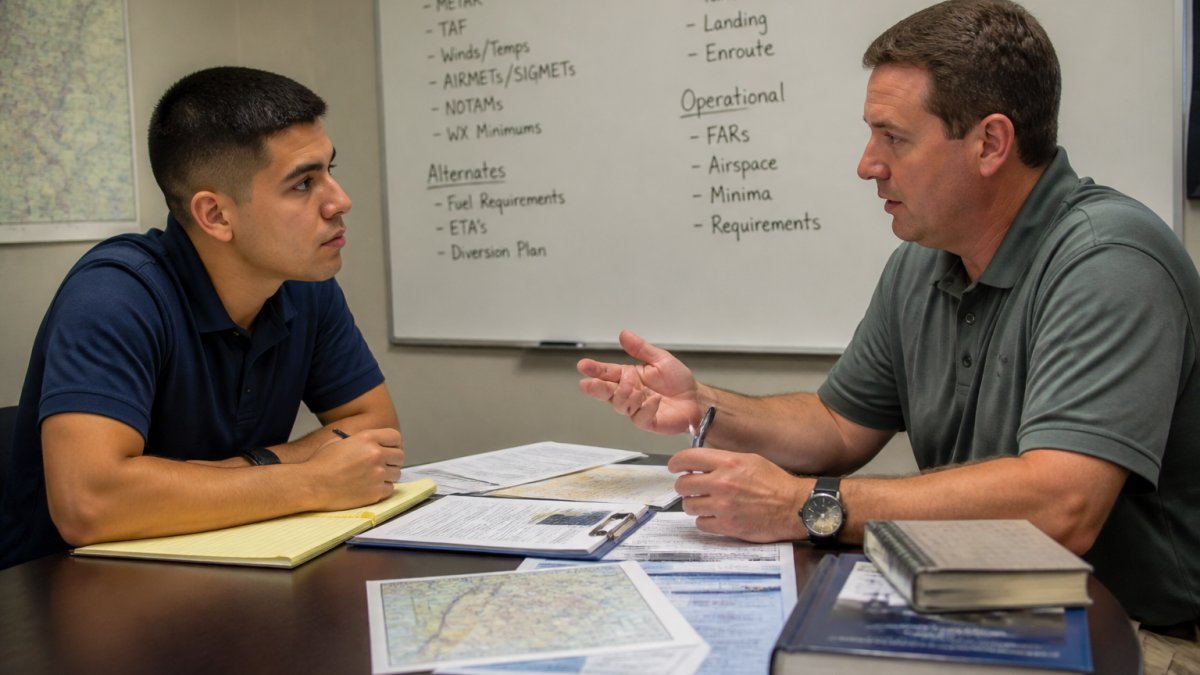
Run mock exams with a partner who asks follow-up questions. Have them push you on weak areas.
At QNH LLC, our 200-classroom-hour curriculum includes practical drills where students defend flight plans out loud.
Track your progress. Note which topics make you stumble. Then drill those until they feel routine.
Handling Difficult Examiner Behavior and Follow-Up Questions
Handling difficult examiner behavior and follow-up questions requires composure, not combativeness. Some examiners push hard on purpose to see how you react under stress, that is part of the test, not a sign you are failing. Below are the behaviors candidates most often misread, with language you can use.
Interruptions
An examiner who cuts you off mid-answer is usually testing whether you can drop a train of thought and pick up a new one, a real skill when a captain or dispatcher changes the question mid-briefing.
- Do: stop talking immediately, listen to the new question, and answer it. Then, if relevant, offer to return: "Happy to come back to the fuel point after this if you'd like."
- Don't: finish your previous sentence over the top of the examiner, or apologize repeatedly. Both read as loss of control.
Skeptical Pushback
"Are you sure about that?" is not always a signal you are wrong. Sometimes it is a probe to see whether you will abandon a correct answer under mild pressure.
- If you are confident: restate your reasoning without defensiveness. "Yes, the regulation requires the alternate to meet the minimums at the estimated time of arrival, and that's what I checked."
- If the pushback reveals a real gap: acknowledge it cleanly. "You're right, I had that backwards. Let me correct it." Correcting yourself is scored better than defending an error.
- If you genuinely don't know whether you're right: say so. "I believe that's correct, but I'd want to verify it against the current guidance before I committed to it."
Silence
Some examiners go quiet after your answer to see if you will keep talking and talk yourself into a mistake. The instinct to fill silence is exactly what the silence is designed to catch.
- Answer the question, then stop. Let the silence sit.
- If the silence stretches and you are unsure whether you answered fully, ask: "Would you like me to go deeper on any part of that?"
- Do not add new claims you did not prepare. Every unplanned sentence is a new surface for a follow-up.
Follow-Up Chains
A common pattern is the examiner asking "Why?" three or four times in a row until you reach the edge of your knowledge. This is not hostility, it is how the examiner finds your boundary.
- Answer each "why" at the level asked. Do not jump ahead to defend a decision the examiner has not challenged yet.
- When you reach the edge, say so plainly: "That's as far as I can take it from memory. Beyond that I'd be checking the manual."
- Do not invent a reason to keep the chain going. A clean stop at your boundary is a passing answer; a fabricated reason is a failing one.
Example Exchange
Examiner: "You filed this alternate. Why?" Candidate: "Because the destination forecast was marginal at the ETA, so I needed a legal alternate within the required range." Examiner: "Why that alternate and not the closer one?" Candidate: "The closer one's forecast was also marginal, so it wouldn't have satisfied the requirement.
Notice the candidate never argues, never apologizes, and never adds unrequested claims. That is the tone to practice.
Practicing Difficult Behavior on Purpose
You cannot rehearse these responses by reading. Have a study partner deliberately interrupt you, go silent, and push back on correct answers, running the same question three times with three different behaviors. The goal is to make the calm response the default, so on test day the examiner's pressure produces your practiced reaction instead of panic. Refining this composure requires integrating exam practice test strategies into your routine until the pressure of the interrogation feels like a natural extension of your technical preparation.
Conclusion: Building Composure Before Test Day
Composure isn't something you're born with. It's something you build through repetition and the right kind of practice.
The candidates who pass their checkride oral exams aren't always the smartest.
QNH LLC prepares aircraft dispatcher candidates for exactly this. Our FAA-approved Part 65 course pairs small class sizes with instruction from airline pilots and former FAA Dispatcher Examiners.
Reserve your spot and walk into test day ready to speak with confidence.
Frequently Asked Questions
How do you handle examiner questions under pressure during a checkride?
Pause before answering. A two-second breath gives your brain time to retrieve information instead of freezing. If the question is complex, break it into parts and answer one at a time. Use a structured response like the STAR method (Situation, Task, Action, Result) or a simple three-part answer: what you know, how you'd verify it, and what you'd do next. If you blank, say so honestly and explain how you'd find the answer in your resources. Examiners care more about your process than perfect recall.
What should you do if you don't know the answer to an examiner's question?
Admit it directly and pivot to process. Saying 'I don't have that memorized, but here's how I'd find it' shows self-awareness and resourcefulness. Walk the examiner through your reference materials, your reasoning, or the regulation you'd check. Never guess or bluff, because examiners spot fabrication quickly and it damages trust. If you partially know the answer, share what you do know and flag the gap. Honesty plus a clear recovery plan often scores better than a shaky correct answer.
How can you stay calm during a pilot checkride?
Practice under timed, realistic conditions before test day. Use mock oral exams with an instructor who asks follow-up questions and pushes back. On the day itself, use deep breathing (four counts in, four counts hold, four counts out) between questions. Keep water nearby, sit upright, and take a five-minute break if the examiner offers one. Remind yourself that the checkride is a conversation about your knowledge, not an interrogation. Preparation plus breathing control reduces the physical symptoms of anxiety.
Can you ask an examiner to repeat or clarify a question?
Yes. Asking for clarification is not a weakness; it shows you listen carefully. If a question is vague or you're unsure what's being asked, say something like 'Could you clarify whether you're asking about the regulation or the operational decision?' This prevents you from answering the wrong question. Examiners would rather repeat a question than watch you ramble in the wrong direction. Just avoid asking for clarification on every question, as that signals you haven't prepared.