 how-to
Aircraft Dispatcher Practical Exam Preparation Tips
Table of Contents
- What the FAA Aircraft Dispatcher Practical Exam Actually Tests
- FAA Aircraft Dispatcher Oral Exam Questions You Should Expect
- Building Your Aircraft Dispatcher Practical Exam Checklist
- Weather Interpretation for Dispatchers: Meteorological Data and NOTAMs
- Manual Flight Planning and Weight and Balance Drills
- Psychological Preparation and Mock-Scenario Drills for the Oral Board
- Common Mistakes That Sink Candidates on Exam Day
- Conclusion
- Frequently Asked Questions
Last Updated: September 17, 2026
What the FAA Aircraft Dispatcher Practical Exam Actually Tests
The aircraft dispatcher practical exam preparation tips that matter most start with understanding what the FAA is really evaluating. The practical test is not a memory quiz. It is a decision-making evaluation.
The Practical Test Standards (FAA-S-8081-10E) explained
FAA-S-8081-10E is the document that lists every task a Designated Pilot Examiner can test during your oral and practical. It covers regulatory knowledge, flight planning, weather analysis, and emergency procedures.
How the oral and practical portions are scored
Your examiner grades each task as satisfactory or unsatisfactory. One unsatisfactory task can end the exam.
FAA Aircraft Dispatcher Oral Exam Questions You Should Expect
FAA aircraft dispatcher oral exam questions almost always start with regulations and end with scenarios. Examiners want to see how you think under pressure.
Regulatory questions on FAR Part 121 and dispatch release
You should know FAR Part 121 dispatch rules cold. This includes fuel requirements, alternate airport selection, and when a dispatch release is required.
Aeronautical decision making and emergency procedures scenarios
Examiners love scenario questions. They'll describe a flight with a mechanical issue or a weather change and ask what you do.
Building Your Aircraft Dispatcher Practical Exam Checklist
A solid aircraft dispatcher practical exam checklist keeps you from forgetting core tasks under pressure. The mistake most candidates make is building the list from memory or from a forum post. Build it from the Airman Certification Standards instead, because that is the document the Designated Pilot Examiner is required to test against.
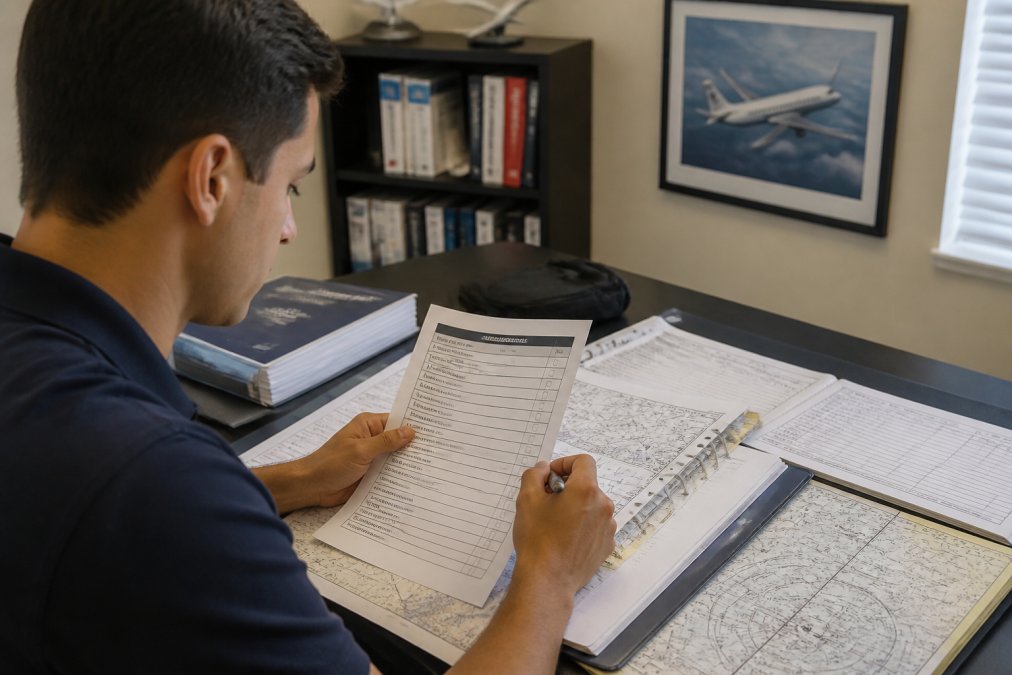
Map your checklist to ACS task areas
A working checklist should mirror the ACS task areas, not a generic study list. A typical structure looks like this:
- Regulations and dispatch authority, FAR Part 121 subparts relevant to dispatch, the dispatch release requirements, and the operating certificate holder's manual.
- Flight planning and the dispatch release, manual flight plan construction, route selection, altitude selection, and the elements the release must contain.
- Meteorology, surface analysis, upper-air charts, terminal forecasts, area forecasts, and how each drives a routing or fuel decision.
- Aircraft performance and weight and balance, takeoff and landing data, runway analysis, and center-of-gravity envelope verification.
- Fuel planning, required fuel, contingency fuel, alternate fuel, final reserve, and additional fuel.
- NOTAMs and enroute limitations, how a NOTAM changes a route, an alternate, or a release.
- Emergency and abnormal procedures, the decision-making flow when something breaks in flight.
- Human factors and crew resource management, fatigue, communication, and workload management.
Turn the checklist into a self-test, not a reading list
A checklist you read is not a checklist you have practiced. Convert each line into a question you must answer out loud, without notes, in under two minutes. This is the interactive drill most guides skip.
A simple self-test loop:
- Pick a task area at random, do not go in order.
- Have a partner (or a recording app) ask you a scenario question tied to that task.
- State your decision, the regulation or manual reference that supports it, and the risk you considered.
- Score yourself: did you cite the rule, apply risk management, and reach a defensible answer?
- Log any task where you hesitated. Those are your study targets for the week.
A worked example: one checklist item, fully drilled
Take "alternate airport selection." A weak checklist says "know alternate rules." A drilled checklist sounds like this:
- What weather minimums apply at the destination and alternate for the approach you plan to use?
- What is the required fuel to reach the alternate, hold, and land?
- What happens if the alternate goes below minimums after you depart?
- Which NOTAMs at the alternate would invalidate it as a legal alternate?
- What is your decision point if the destination forecast deteriorates enroute?
Weather Interpretation for Dispatchers: Meteorological Data and NOTAMs
Weather interpretation for dispatchers is where many candidates lose points. You need to read meteorological data the way a dispatcher does, not the way a private pilot does. A private pilot asks "can I fly?" A dispatcher asks "what does this weather do to my route, my fuel, and my alternate?"
Read weather as a chain of decisions, not a list of products
A dispatcher's weather review follows a sequence. Each step feeds the next:
- Surface analysis, identify frontal boundaries, pressure systems, and the air masses driving the route.
- Upper-air charts, check winds aloft, because they set your groundspeed, fuel burn, and whether a different altitude is cheaper.
- Terminal and area forecasts, determine whether the destination and alternate will meet the minimums for the approach you plan to use.
- Convective and turbulence outlooks, decide whether the route needs to move, and by how much.
- Icing forecasts, decide whether the planned altitude is legal and safe for the aircraft type.
- NOTAMs, confirm that the route, the destination, and the alternate are actually usable as planned.
How weather actually changes a dispatch release
This is the part most study guides skip. Weather is not a separate topic, it is an input to the release. A few concrete examples:
- A forecast ceiling at the destination that sits near the approach minimums may force you to add fuel for a second approach, hold, or diversion.
- A stronger-than-forecast headwind aloft increases fuel burn and may push you to a lower altitude or a different route.
- A convective line along the filed route may require a re-route that adds distance, which adds fuel, which may change your alternate.
- An icing forecast at your planned cruise altitude may force a lower altitude, which changes winds, which changes fuel again.
- A NOTAM closing the primary alternate invalidates your alternate planning and forces a new one, often with different weather minimums.
Practice with live data, not textbook charts
Practice reading real weather briefings daily. The FAA's Aviation Weather Center provides live data you can practice with. Use it every day before your exam.
A daily practice routine that actually builds the skill:
- Pick a real city pair and a real departure time.
- Pull the current surface analysis, winds aloft, terminal forecasts, and NOTAMs for both ends.
- Build a manual flight plan and a dispatch release for that flight.
- Then ask: what would change if the destination forecast dropped 300 feet, or if the alternate closed, or if the winds aloft shifted 20 knots?
- Write down the new fuel and alternate numbers each time.
NOTAMs are part of weather, not a separate topic
Candidates often treat NOTAMs as a paperwork chore. Examiners treat them as a decision input. A runway closure, a navaid outage, or a changed approach procedure can invalidate the weather planning you just did.
Manual Flight Planning and Weight and Balance Drills
Manual flight planning is the skill examiners test hardest. They want to see you build a flight plan without software doing the math.
Psychological Preparation and Mock-Scenario Drills for the Oral Board
Most guides skip psychological preparation. That's a mistake. The oral board is as much a mental test as a technical one.
Common Mistakes That Sink Candidates on Exam Day
The biggest mistake is studying for the written exam and hoping it covers the oral. It doesn't.
Other common errors:
- Skipping manual flight planning practice
- Ignoring NOTAMs and enroute limitations
- Memorizing answers instead of understanding rules
- Not practicing out-loud explanations
- Rushing through weight and balance drills
Conclusion
The practical exam rewards candidates who practice judgment, not just recall. Build your checklist, drill manual flight planning, and rehearse scenarios out loud until they feel routine.
Frequently Asked Questions
What topics are covered in the aircraft dispatcher practical exam?
The practical exam covers the full range of dispatcher duties: weather analysis and interpretation, manual flight plan construction, weight and balance computations, regulatory knowledge from the Federal Aviation Regulations, aeronautical decision making, emergency procedures, and operational control under FAR Part 121. You will also be tested on reading meteorological data, NOTAMs, and performance data. The examiner expects you to apply these topics to realistic scenarios, not just recite facts.
How long does the aircraft dispatcher practical exam take?
Most practical exams run four to six hours, though the actual time depends on how smoothly you move through each scenario. The oral questioning portion alone can take one to two hours before you transition to the practical flight planning exercise. Designated Pilot Examiners pace the exam based on your responses, so thorough preparation with timed mock scenarios helps you stay on track and avoid running out of steam.
How should I prepare for the oral portion of the dispatcher exam?
Start by studying the Practical Test Standards (FAA-S-8081-10E) to understand exactly what the examiner must see you demonstrate. Practice answering FAA aircraft dispatcher oral exam questions out loud with a study partner or instructor. Run through mock scenarios that force you to defend a dispatch release, explain alternate airport selection, and justify fuel planning decisions. Focus on understanding the why behind each regulation, not just memorizing answers.
What happens if I fail a section of the aircraft dispatcher practical exam?
If you fail a section, the examiner will note the specific task you did not meet and stop the exam at that point. You will need to retest on the failed areas, and depending on the examiner and the severity of the failure, you may need to repeat the entire practical exam. The FAA requires a 30-day waiting period before you can retest, though you can apply for a shorter wait if you receive additional training from an approved provider.