 how-to
Skills Required for Successful Aircraft Dispatching
Last Updated: November 4, 2026
Quick Summary
The skills required for successful aircraft dispatching go beyond an FAA certificate to include clear communication, weather analysis, and sound decision-making under pressure. Dispatchers must also show composure, detail discipline, and curiosity, since automation handles computation while humans handle context.
- The FAA requires an airman certificate under Part 65, plus a knowledge test and practical exam.
- Clear communication covers ATC clearances, pilot briefings, and pushing back on unsafe flight plans.
- Strong weather analysis means interpreting turbulence, icing, and convective activity and building alternates early.
- The common decision-making failure is waiting for certainty, which is itself a decision.
- Automation handles computation while dispatchers handle context, so judgment matters more than ever.
Table of Contents
- Flight Dispatcher Qualifications: What the FAA Requires and What Airlines Expect
- Aircraft Dispatcher Communication Skills That Keep Flights Safe
- Aircraft Dispatcher Weather Analysis: Reading the Sky Before the Flight Leaves the Gate
- Aircraft Dispatcher Decision-Making Skills Under Real Operational Pressure
- The Psychological Profile of a Successful Aircraft Dispatcher
- How Automation and AI Are Reshaping Aircraft Dispatching
- Building Your Skills Through FAA-Approved Aircraft Dispatcher Training
- Frequently Asked Questions
Flight Dispatcher Qualifications: What the FAA Requires and What Airlines Expect
The skills required for successful aircraft dispatching start with a certificate, but they don't end there. The FAA sets the floor. Airlines set the bar. Knowing the gap between the two is what separates a licensed graduate from a hireable one.
The FAA requires an airman certificate under Part 65, and candidates must pass a knowledge test and practical exam. But hiring managers look for something harder to certify: judgment under pressure, sharp analytical skills, and the discipline to hold operational control of a flight from the ground.
The FAA aircraft dispatcher certification standards spell out the paperwork. They don't describe the job. That's where the real skills list begins.
Aircraft Dispatcher Communication Skills That Keep Flights Safe
Clear communication is the backbone of aircraft dispatching. A dispatcher relays weather, fuel loads, and routing to pilots, and every word carries weight. Poor phrasing creates confusion. Confusion creates risk.
Interpersonal communication shows up in three places:
- ATC communication: Passing and receiving clearances without ambiguity
- Pilot briefings: Explaining a dispatch release so the crew understands the risk picture
- Collaborative decision making: Pushing back when a flight plan looks unsafe
A common mistake is treating communication as a personality trait. It's a skill. Dispatch resource management training builds it the same way CRM builds it for flight crews. If you want to see how structured crew training sharpens these habits, read why CRM training matters for dispatchers.
Aircraft Dispatcher Weather Analysis: Reading the Sky Before the Flight Leaves the Gate
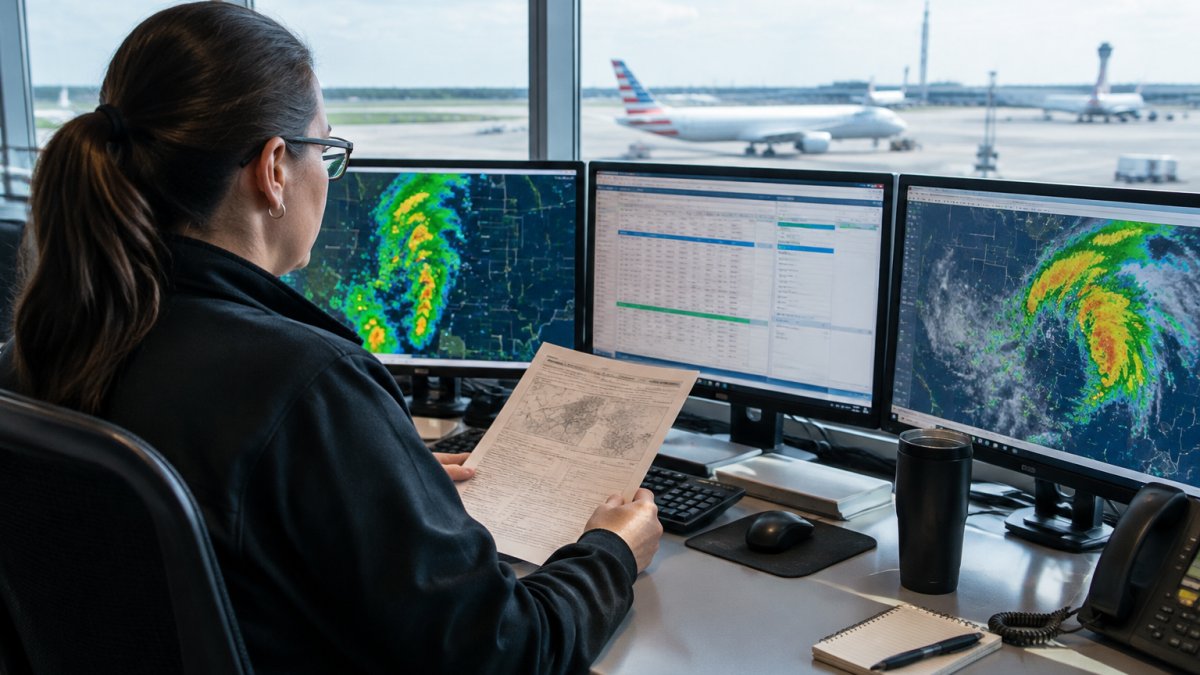
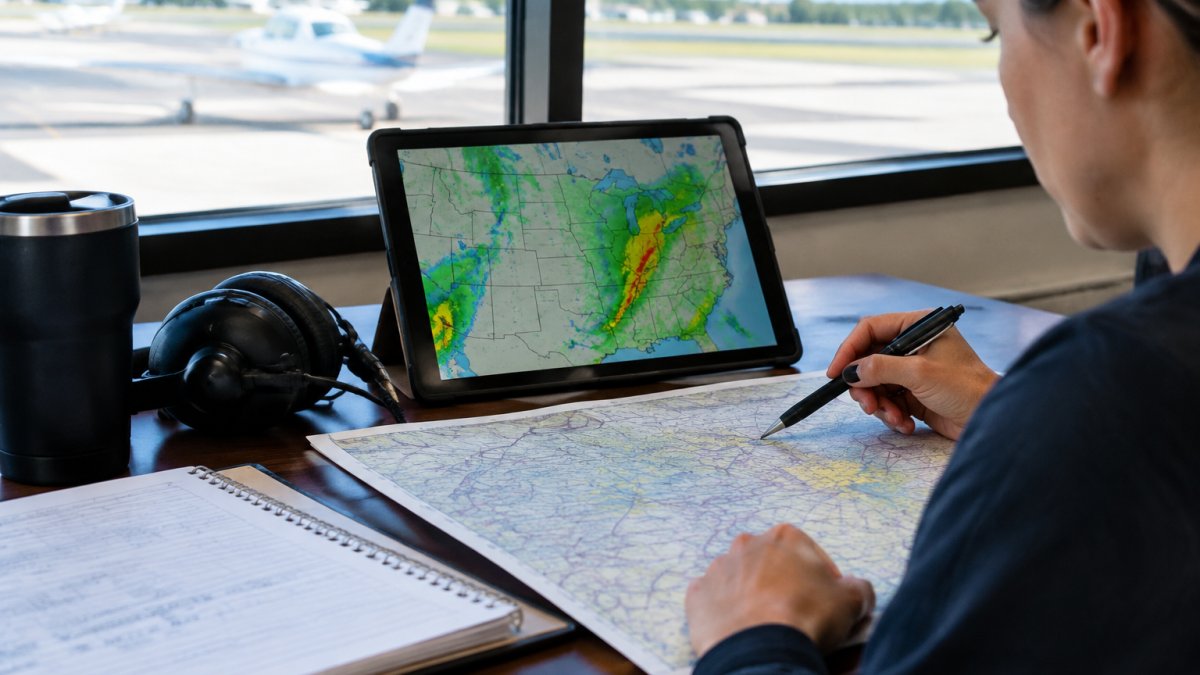
Meteorology is where weak candidates get exposed. Weather briefings, NOTAMs, and fuel planning all hinge on reading conditions correctly, not just checking a forecast app.
Strong weather analysis means:
- Interpreting turbulence, icing, and convective activity
- Building alternate routing before conditions force it
- Reading METARs and TAFs with real fluency
Aviation safety depends on it. A dispatcher who misreads a frontal system can approve a route a pilot should never fly. For a practical walkthrough, see how to read aviation weather reports accurately.
Aircraft Dispatcher Decision-Making Skills Under Real Operational Pressure
Aeronautical decision-making separates a dispatcher from a clerk. The job is time-sensitive, and the environment can shift quickly. Delays cascade. A runway closes. A crew times out. What matters is not whether you can recite a decision model but whether you can run one while the clock is moving.
Most practitioners describe dispatch judgment as a loop rather than a single choice: detect the change, assess the operational impact, generate at least two viable options, pick one, then monitor for the next change. The failure mode is almost never picking the wrong option first. It is failing to notice that the situation moved while you were deciding.
Here is how that loop plays out in a common disruption. A frontal system is forecast to reach the destination field near the estimated arrival time, and the crew is approaching its duty limit.
- Detect: The dispatcher sees the updated forecast and the duty clock at the same time, not one after the other.
- Assess: The question is not "is the weather bad?" but "which combination of alternate, delay, or crew swap keeps the release legal and the risk acceptable?"
- Generate options: Hold for a later arrival with a fresh crew, divert to a filed alternate with adequate fuel, or cancel and re-dispatch. Each has a different cost in fuel, passenger impact, and downstream schedule.
- Decide and monitor: The dispatcher picks the option that preserves operational control, then keeps watching the forecast in case the front speeds up.
Critical thinking and problem-solving carry the load here, but so does stress tolerance. Under a ground stop, someone has to weigh fuel, crew duty limits, and passenger impact at once, and the answer is rarely clean.
A simple framework used in dispatch training:
| Situation | First Move | Why It Works |
|---|---|---|
| Weather closing in | Build alternates early | Removes panic decisions later |
| Crew duty running out | Flag it at dispatch release | Prevents illegal releases |
| Aircraft mechanical | Coordinate with maintenance | Keeps operational control intact |
| Multiple flights affected | Triage by risk, not by order received | Prevents the loudest problem from consuming the whole shift |
Watch out: the most common failure is waiting for certainty. In dispatching, waiting is a decision, and usually the wrong one. The second most common is deciding once and never revisiting the call, which is how a manageable delay becomes an illegal release.
Decision-making is trainable. Scenario-based practice, where an instructor injects a weather change or a mechanical while you are mid-release, builds the loop faster than reading about it. That is the same logic behind dispatch resource management training, which treats judgment as a crew skill rather than a personality trait.
The Psychological Profile of a Successful Aircraft Dispatcher
What kind of person thrives in this seat? The one who stays calm while everything moves. But calm is the visible surface of a set of cognitive traits that hiring managers and instructors quietly screen for. Most skills lists stop at "detail-oriented" and "works well under pressure." The useful question is which underlying abilities produce those behaviors.
Three traits show up again and again:
- Composure: steady under pressure, no drama
- Detail discipline: catches the small error before it grows
- Curiosity: asks why the fuel number changed
Underneath those, practitioners tend to point to a few cognitive capacities:
- Working memory: holding a fuel figure, a duty clock, and a weather trend in mind at once without dropping one. Dispatch releases are built from several numbers that interact, and losing one mid-task is how errors slip through.
- Spatial reasoning: reading a route, a radar image, and a terminal layout and mentally rotating them into a single picture of where the aircraft will be and when.
- Pattern recognition: noticing that a set of conditions resembles a previous disruption before the forecast confirms it. Experienced dispatchers often describe a "this feels like last winter" instinct that is really accumulated pattern memory.
- Cognitive flexibility: switching from a planned release to an emergency re-route without carrying the old plan forward out of habit.
Multi-tasking gets romanticized. In practice, it means prioritizing ruthlessly and knowing what can wait. A dispatcher who tries to hold every flight in active attention at once will drop the one that matters. The skill is sequencing attention, not splitting it.
A common pattern is that strong candidates show these traits outside the job before they ever sit in a dispatch office: they run complex logistics for a volunteer group, they play strategy games that reward planning under uncertainty, or they gravitate toward roles where a small error has visible consequences. That history is a better predictor than a self-assessment.
Watch out: treating composure as the whole profile. A dispatcher who stays calm but never questions a number is calm and wrong. The profile that succeeds pairs steadiness with active skepticism about the inputs.
If you want the fuller skills picture, explore what skills successful flight dispatchers need.
How Automation and AI Are Reshaping Aircraft Dispatching
Flight planning software now crunches routes and fuel loads in seconds. AI flags weather trends faster than a human can scan. Does that shrink the skills list? No. It shifts it.
Technical proficiency still matters, but judgment matters more. Automation handles computation. Dispatchers handle context. The person who blindly trusts the software is a liability. The person who questions it is an asset.
Aeronautical decision-making doesn't automate. It's the human layer on top of the machine. Choosing the right tools is part of the job, and which flight planning software dispatchers should choose is worth understanding before you sit the exam.
Building Your Skills Through FAA-Approved Aircraft Dispatcher Training
Skills can be taught. That's the good news. The FAA-approved route builds them in a structured way, from aerodynamics and weight and balance to aviation law.
What to look for in a program:
- Classroom hours that exceed the minimum
- Instructors with real airline and examiner experience
- Small classes that allow individual attention
The FAA Part 65 certification requirements define the curriculum floor. Strong programs go past it. At QNH LLC, our 200-classroom-hour course pairs meteorology and aerodynamics with practical weight and balance work, taught by airline pilots and former FAA examiners in small classes. If you're ready to build the full skill set, review FAA-approved dispatcher schools and compare what each one actually delivers.
Frequently Asked Questions
What skills does a good aircraft dispatcher need?
A good aircraft dispatcher combines technical proficiency with strong soft skills. On the technical side, that means understanding meteorology, aerodynamics, weight and balance, FAA regulations, and flight planning systems. On the soft side, dispatchers need clear communication, critical thinking, time management, and the ability to stay calm under pressure. Because dispatch releases are legally shared with the pilot in command, attention to detail and regulatory compliance are non-negotiable. The best dispatchers also develop situational awareness that lets them anticipate problems before they cascade into delays or safety issues.
How important is communication in aircraft dispatching?
Communication is one of the most important aircraft dispatcher communication skills because the job is built on shared operational control. Dispatchers coordinate constantly with pilots, air traffic control, maintenance, and station operations. A dispatcher who cannot convey a weather concern or fuel plan clearly in a time-sensitive environment creates risk. Strong interpersonal communication also matters during irregular operations, when dispatchers must explain delays and reroutes to crews and managers without adding friction. Training programs that emphasize ATC communication and collaborative decision making produce dispatchers who are hireable from day one.
Why do aircraft dispatchers need strong decision-making skills?
Aircraft dispatcher decision-making skills matter because dispatchers make judgment calls that affect safety and cost in real time. When weather closes an airport, a mechanical issue grounds an aircraft, or a NOTAM changes approach minimums, the dispatcher must weigh fuel, crew duty time, passenger impact, and regulatory limits quickly. There is rarely one perfect answer. Strong decision-making means gathering the right information, consulting the pilot in command, and committing to a plan that keeps the flight within safe margins. That skill is built through scenario practice and mentorship, not memorization alone.
How can you develop the skills needed for aircraft dispatching?
Start with a structured FAA-approved Part 65 certification course that covers meteorology, aerodynamics, aviation law, and weight and balance in depth. Look for small class sizes and instructors with real airline or FAA examiner experience, since scenario-based discussion builds judgment faster than lectures alone. Practice reading weather briefings and NOTAMs daily, and work through flight planning exercises until fuel and alternate calculations feel routine. After certification, seek mentorship from senior dispatchers and treat every irregular operation as a learning case. Soft skills like stress tolerance and multi-tasking improve with deliberate practice over time.
The gap between a certificate and a career comes down to judgment, communication, and composure under pressure. Those are trainable, but only with the right instruction. QNH LLC builds them through FAA-approved Part 65 training, small classes with individual attention, and instructors who have worked the dispatch desk and the examiner's chair. Reserve your seat and start preparing for a career where every decision counts.