 blog
blog
5 Best FAA Approved Dispatcher Schools for 2026
Table of Contents
- What Makes a Dispatcher School Worth Your Time
- Part 65 Aircraft Dispatcher Certification Requirements
- How to Evaluate FAA Approved Dispatcher Schools
- Aircraft Dispatcher Training Duration: What to Expect
- Aircraft Dispatcher Salary and Career Outlook
- Financial Aid, GI Bill Eligibility, and Mentorship After Graduation
- Questions to Ask Before You Enroll in FAA Approved Dispatcher Schools
- Frequently Asked Questions
Last Updated: September 16, 2026
What Makes a Dispatcher School Worth Your Time
Choosing an FAA approved dispatcher school is the difference between a certificate that gets you hired and one that collects dust. The best programs combine Part 65 compliance, instructors with flight operations experience, and enough hands-on flight planning to defend a dispatch release in front of an examiner.
Part 65 Aircraft Dispatcher Certification Requirements
Part 65 aircraft dispatcher certification requirements come down to three things: age, experience, and passing the knowledge and practical tests. You must be at least 23, hold a high school diploma or equivalent, and pass both the FAA Aircraft Dispatcher Knowledge Test (ADX) and a practical exam with an FAA inspector or designated examiner.
- Age: 23 or older at certification
- Education: High school diploma or equivalent
- Knowledge test: FAA ADX written exam
- Practical test: Oral and practical evaluation with an examiner
- Training: Structured ground school covering the FAA's required subject areas
How to Evaluate FAA Approved Dispatcher Schools
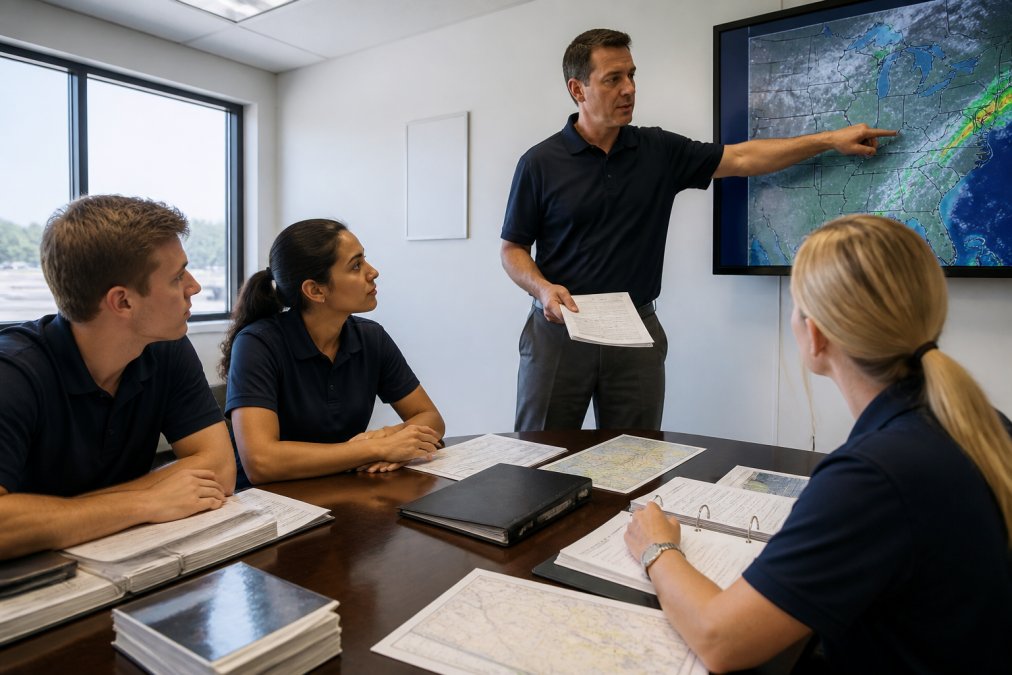
Evaluate an FAA approved dispatcher school by looking past the approval certificate at three areas: accreditation and regulatory standing, instructor credentials, and whether the classroom builds the skills the practical exam tests. Approval is the floor, not the ceiling.
Accreditation and Regulatory Compliance
Accreditation and regulatory compliance confirm a school meets recognized industry standards beyond minimum FAA approval. A Part 65 certificate lets a school administer required training, but accreditation signals independent review of curriculum quality.
Instructor Credentials and Classroom Approach
Instructor credentials matter more than glossy facilities. The best programs staff classrooms with people who have held dispatch certificates, worked airline flight operations, or served as FAA Dispatcher Examiners, experience that turns theory into decisions you can defend.
Aircraft Dispatcher Training Duration: What to Expect
Aircraft dispatcher training duration typically runs 200 classroom hours for a full Part 65 certification course, the standard most in-person programs follow and the minimum the FAA expects for comprehensive ground school. Accelerated formats compress the material into fewer weeks; part-time formats stretch it across months.
Online vs. In-Person Training Options
Online training offers flexibility for working professionals who cannot commit to fixed classroom hours. Self-paced courses let you study around a full-time job at lower cost, but you lose live instruction, peer discussion, and immediate feedback on complex computations.
| Format | Typical Duration | Best For | Trade-off |
|---|---|---|---|
| In-person, full-time | 200 classroom hours over several weeks | Career changers, first-time candidates | Higher time and cost commitment |
| In-person, part-time | 200 hours spread across months | Working airline employees | Longer runway to certification |
| Online, self-paced | Varies by learner | Self-directed studiers | Less live feedback and structure |
| Hybrid | Mixed classroom and online | Candidates needing flexibility plus instruction | Requires discipline to keep pace |
Aircraft Dispatcher Salary and Career Outlook
Aircraft dispatcher salary tracks employer tier more than any other variable. The Bureau of Labor Statistics groups dispatchers under transportation and material moving occupations, and the BLS occupational outlook data is the only figure worth quoting because school marketing pages routinely inflate it. What the BLS data shows is a wide band: entry-level dispatchers at regional carriers and charter operators sit near the bottom of the range, while dispatchers at major airlines with seniority and international authority sit near the top.
The pay ladder most guides skip:
- Regional airline or charter: The standard entry point. Lower experience thresholds, faster hiring cycles, and starting pay that reflects the smaller operation. This is where you build operational control hours.
- Major airline: Pulls primarily from regional ranks and from internal candidates. Pay jumps substantially, and shift differentials for nights, weekends, and holidays add to base.
- Cargo and international operations: Often the top of the pay band. Requires the deepest experience and frequently a longer tenure at a major before moving over.
Regional vs. Major Airline Hiring Trends
Regional airlines hire dispatchers more frequently and with lower experience thresholds, making them the common entry point. Major airlines pull from regional ranks, and internal candidates often have a leg up. A common pattern is two to five years at a regional before a major interview.
A school that promises "guaranteed job placement" is overselling. No program can guarantee a hiring decision made by an airline. What a good program can offer is interview preparation, industry referrals, and a track record you can verify.
Interactive Comparison Matrix: Cost, Duration, and Format
This is the section most dispatcher school pages avoid, because a side-by-side table makes it easy to compare and harder to sell. Fill in this matrix for every school you consider, the point is forcing every program to answer the same questions in the same format.
| Factor | What to Record | Why It Matters |
|---|---|---|
| Total tuition | Full program cost, not per-credit | The number that hits your bank account |
| Classroom hours | Confirm 200 for a full Part 65 course | Anything less cuts depth somewhere |
| Format | In-person, online, or hybrid | Determines whether you get live feedback |
| Class size | Maximum students per instructor | Small classes mean individual correction |
| ADX first-attempt pass rate | Ask for the actual number | The clearest quality signal a school has |
| Placement rate | Graduates hired within six months | Tells you if the industry connections are real |
| Funding eligibility | Federal aid, VA benefits, payment plans | Determines whether you can afford it at all |
| Post-graduation support | Mentorship, refreshers, alumni network | Bridges the gap to your first desk |
Financial Aid, GI Bill Eligibility, and Mentorship After Graduation
Financial aid and GI Bill eligibility are the two most overlooked factors when comparing FAA approved dispatcher schools, and the highest-intent questions a prospective student asks. Here is how the mechanics work.
Ask for the school's federal school code and its VA approval status in writing before you enroll. A school that cannot produce both documents is not set up to process your benefits, no matter what the website says.
Post-Graduation Mentorship Programs
Mentorship after graduation is the factor competitors almost never discuss, and it is where new dispatchers struggle most. The transition from classroom to dispatch desk is a cliff: guided exercises become a live weather briefing at 2 a.m. with a captain waiting on your release. A program that pairs graduates with working dispatchers, offers refreshers, or maintains an alumni network gives you a rope down that cliff.
- A named point of contact after graduation. Not a general support email, a person.
- Refresher access. Can you sit in on a flight planning session or review a real release with an instructor after you certify?
- Alumni network. Working dispatchers who can answer a question at 2 a.m. are worth more than any textbook.
- Interview preparation. Regional and major airline interviews test operational control judgment, not memorization.
Regional vs. Major Airline Hiring Trends
A school that promises "guaranteed job placement" is overselling. No program can guarantee a hiring decision made by an airline. What a good program can offer is interview preparation, industry referrals, and a track record you can verify.
QNH LLC's program is built around this gap. Instructors include college professors, airline pilots, and former FAA Dispatcher Examiners, and the Chief and Lead Instructors are Sheffield Graduates who teach using the Socratic Method. That method forces you to reason through operational control decisions rather than memorize answers, exactly what the practical exam and airline interview demand.
Questions to Ask Before You Enroll in FAA Approved Dispatcher Schools
Ask these questions before you pay a deposit at any FAA approved dispatcher school. The answers reveal whether a program is built to get you certified and hired, or just to fill seats.
- What is your first-attempt pass rate on the ADX exam and practical test?
- Who teaches the classroom, and what are their operational credentials?
- How many classroom hours are included, and is the curriculum current?
- What happens if I fail the ADX on my first attempt? Is there a retake policy?
- Does the program include practical training in weight and balance and flight planning?
- Do you offer job placement assistance, and can you share recent graduate outcomes?
- Is the program eligible for federal financial aid or VA benefits?
- What support exists after graduation if I need help on the job?
Frequently Asked Questions
Where can I find an FAA-approved flight dispatcher course?
FAA-approved dispatcher courses appear on the FAA's list of Part 65 approved training programs. Schools must meet federal curriculum standards covering meteorology, navigation, aircraft performance, federal regulations, and flight planning. When comparing FAA approved dispatcher schools, verify current FAA approval, ask about written test pass rates, and confirm the program includes practical exam preparation. In-person programs with small classes and experienced instructors typically provide stronger preparation for the ADX exam and dispatch release defense.
How long is FAA dispatcher school?
Aircraft dispatcher training duration varies by program format. FAA Part 65 requires a minimum of 200 hours of approved instruction, which most full-time in-person programs complete in 5 to 7 weeks. Part-time or online options stretch the same curriculum over 3 to 6 months. Accelerated learning formats pack classroom hours into intensive daily sessions. The right pace depends on your schedule, prior aviation knowledge, and how quickly you absorb aeronautical knowledge and practical flight planning skills.
How much do FAA dispatchers make?
Aircraft dispatcher salary varies by airline type and experience. Regional carriers typically pay entry-level dispatchers in the $40,000 to $55,000 range, while major airlines pay significantly more, often exceeding $100,000 with seniority. Pay scales, shift differentials, and location affect total compensation. The FAA reports a continuing need for qualified dispatchers, and career advancement into supervisory or operational control roles can raise earnings further. Check current industry salary surveys for updated figures.
Do I need a college degree to become an aircraft dispatcher?
No college degree is required for the Part 65 aircraft dispatcher certification. Candidates must be at least 23 years old, read and speak English fluently, pass a written test, and complete an approved training course or meet experience alternatives. A high school diploma or equivalent is typical. What matters most is completing 200 hours of approved instruction, passing the practical exam, and demonstrating competency in weather briefing, fuel planning, emergency procedures, and operational control.