 how-to
Weight and Balance Computations: Practical Training Guide
Table of Contents
- Why Weight and Balance Computations Decide Whether You Get Hired
- The Core Concepts You Must Master Before Practicing
- Weight and Balance Practice Problems That Build Real Skill
- How to Build an Aircraft Weight and Balance Worksheet That Works
- Aircraft Center of Gravity Calculation Examples From Real Flight Plans
- Common Errors in Pilot Weight and Balance Logs (and How to Catch Them)
- Competency Assessment: How to Know You're Job-Ready
- Frequently Asked Questions
Last Updated: October 12, 2026
Why Weight and Balance Computations Decide Whether You Get Hired
Weight and balance is the arithmetic that decides whether an aircraft is legal to fly, and it is the first thing a dispatcher or examiner asks you to defend.
The reason is simple: weight and balance computations touch every part of a flight plan.
Below, we break down the concepts, the practice problems, and the competency checks that actually prepare you for a dispatcher desk.
The Core Concepts You Must Master Before Practicing
You cannot practice weight and balance problems until the vocabulary is automatic. Aircraft weight and balance is the process of confirming that an aircraft's total weight stays within its limits and that its center of gravity falls inside the approved range for every phase of flight.
Weight Limits, Center of Gravity, and the Loading Envelope
Maximum takeoff weight is the heaviest the aircraft can be when it starts its takeoff roll. Maximum landing weight is the limit for touchdown, and it is often lower than takeoff weight because of structural stress on landing. Empty weight is the aircraft with no payload or usable fuel, and useful load is everything you can add: payload, fuel, passengers, and baggage.
Center of gravity is the point where the aircraft would balance if suspended. The loading envelope is the chart that shows which combinations of weight and CG are legal. Stay inside it, and the aircraft behaves as designed. Step outside it, and you are testing the airframe.
Arm, Moment, Datum, and Station: The Vocabulary of Load Distribution
Arm is the horizontal distance from a reference point to an item's location. That reference point is the datum, an imaginary vertical plane the manufacturer chooses. A station is a named position along the fuselage, and a moment is weight multiplied by arm.
| Term | Definition | Unit |
|---|---|---|
| Arm | Distance from datum to an item | Inches |
| Moment | Weight x arm | Pound-inches |
| Datum | Manufacturer's reference plane | Fixed |
| Station | Named fuselage position | Inches from datum |
| Moment index | Moment divided by a constant | Simplified units |
A common mistake is mixing up arm and station. They are related, but the datum does not always sit at station zero, so read the aircraft flight manual before you calculate anything.
Weight and Balance Practice Problems That Build Real Skill
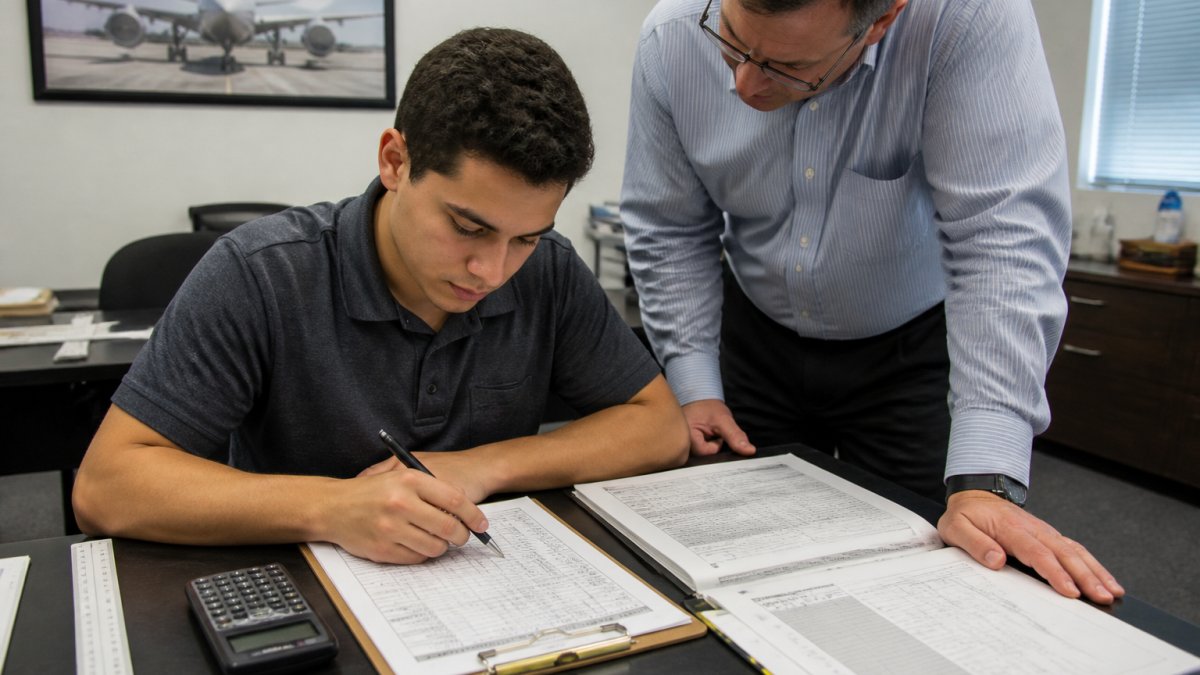
Practice problems are where the concepts become reflexes. The goal is not to solve one problem correctly but to solve fifty problems the same way, every time, without skipping a step.
Worked Example: Narrow-Body Jet With Full Passenger Load
This example uses round numbers so the arithmetic stays visible.
Assume a datum at the nose, arms in inches, and moments in pound-inches.
| Item | Weight (lb) | Arm (in) | Moment (lb-in) |
|---|---|---|---|
| Empty weight | 90,000 | 620 | 55,800,000 |
| Crew (2) | 400 | 200 | 80,000 |
| Passengers (150) | 25,500 | 700 | 17,850,000 |
| Baggage | 4,000 | 900 | 3,600,000 |
| Fuel | 20,000 | 650 | 13,000,000 |
| Zero-fuel + fuel total | 139,900 | , | 90,330,000 |
Divide total moment by total weight to find the CG:
90,330,000 ÷ 139,900 = 645.7 inches
Now check two things. First, is 139,900 lb at or below maximum takeoff weight? Second, does 645.7 inches fall inside the forward and aft CG limits for that weight?
The trick is to work in a fixed order and never jump around: empty weight, crew, passengers, baggage, fuel.
Answer Key and Error Explanations
When you check your answer, do not just compare the final CG. Trace back through each moment. If the total is wrong, the error is almost always in one of these places:
- Transposed arm value. 620 typed as 260. The moment changes by tens of millions of pound-inches and the CG swings wildly.
- Forgotten item. Fuel added after the total was struck, or baggage left off entirely.
- Unit mismatch. Mixing pound-inches with a moment index that has already been divided by a constant such as 1,000 or 10,000.
A useful self-check: recompute the total moment by summing the individual moments a second time in a different order. If the two totals disagree, you have a transcription error, not a math error.
Build a Problem Set That Mirrors the Job
Random textbook problems build familiarity. Sequenced problems build competency. A practical set for job readiness looks like this:
- Single-variable drills. Ten problems that change only the fuel load, so you see how CG moves with one input.
- Full load sheets. Ten problems built from raw data, no pre-filled table, so you practice the whole workflow.
- Injected-error problems. Five load sheets that already contain a mistake. Your job is to find it, not to solve from scratch. This is the skill interviewers actually probe.
- Timed runs. Three load sheets under a clock, because dispatch desks do not offer unlimited time.
Work each set until you can complete it without referring back to the concept definitions. That is the point at which practice has become skill.
How to Build an Aircraft Weight and Balance Worksheet That Works
An aircraft weight and balance worksheet is a repeatable template that forces you to account for every item in the same order, every time. Build it once, and you remove the guesswork from every future calculation.
Spreadsheet vs. Manual Calculation: When to Use Each
Spreadsheets are faster and reduce arithmetic errors, but they hide mistakes. If a formula is wrong, every answer is wrong, and you will not notice. Manual calculation is slower but it forces you to understand each step.
| Method | Best For | Watch Out For |
|---|---|---|
| Spreadsheet | High-volume flight planning | Broken formulas, stale data |
| Manual | Learning, exam prep, verification | Arithmetic slips |
| Hybrid | Real dispatcher work | Requires discipline to cross-check |
Learn manually first, then move to a spreadsheet once you can spot a wrong answer by instinct. The Federal Aviation Administration publishes guidance on weight and balance in its handbook series, which is worth reading alongside your aircraft-specific documents. FAA Weight and Balance Handbook
Aircraft Center of Gravity Calculation Examples From Real Flight Plans
Real flight plans add complications that textbook problems skip. Fuel burns off during flight, so the CG shifts. Passengers move. Cargo gets loaded late.
Aircraft center of gravity calculation examples from actual dispatch work usually include a takeoff CG, an in-flight CG, and a landing CG. If any one of those falls outside the envelope, the flight plan is not legal.
Common Errors in Pilot Weight and Balance Logs (and How to Catch Them)
Common errors in pilot weight and balance logs fall into predictable categories, and most of them are caught by the same habit: reading your own work as if someone else wrote it.
- Using the wrong empty weight after a modification
- Forgetting to update the arm values when equipment is added
- Confusing maximum takeoff weight with maximum landing weight
The fix is a checklist. Before you sign a weight and balance report, run through each line item and confirm it against the source document. It takes two minutes and it catches almost everything.
Competency Assessment: How to Know You're Job-Ready
You are job-ready when you can build a load sheet from raw data, catch an injected error, and explain your reasoning out loud without notes. That is the standard employers use when they interview dispatchers. The problem is that "job-ready" is usually described as a feeling. It should be a checklist you can hand to a hiring manager.
A Readiness Rubric You Can Score Yourself Against
Score each row from 1 (needs work) to 4 (interview-ready). A total of 20 or higher, with no row below 3, is a reasonable threshold for walking into an interview with confidence.
| Competency | 1, Novice | 2, Developing | 3, Proficient | 4, Interview-Ready |
|---|---|---|---|---|
| Accuracy | Frequent arithmetic errors | Occasional slips | Correct on routine loads | Correct on complex, multi-leg loads |
| Speed | No time pressure tolerated | Needs extra time | Completes a standard load sheet in a normal working window | Completes under time pressure without rushing errors |
| Documentation | Skips source references | References some items | Cites the flight manual and W&B report for each figure | Produces a clean, auditable load sheet a supervisor can sign |
| Error detection | Cannot spot a planted mistake | Finds obvious errors | Finds subtle errors with a checklist | Finds and explains the root cause of an injected error |
| Decision-making | Freezes when out of limits | Knows it is wrong but not what to do | Proposes a legal fix | Proposes and defends the best fix, weighing fuel, payload, and CG |
How to Use the Rubric
A structured learning path matters here. Random practice problems build familiarity; sequenced practice builds competency. We group training into three stages, each with a measurable pass criterion:
- Concept mastery. Define arm, moment, datum, station, and the weight limits without notes. Pass criterion: a written quiz with no reference material.
- Guided practice. Complete ten full load sheets with an instructor reviewing each step. Pass criterion: three consecutive correct load sheets with no process corrections.
- Timed assessment. Complete a load sheet with an injected error under a clock and explain your fix out loud. Pass criterion: correct result, error identified, and a defensible explanation.
Each stage has a pass criterion, so you always know where you stand. If you cannot pass stage two, more stage three practice will not help, you have a process gap, not a speed gap.
Demonstrating Readiness to an Employer
Bring evidence, not adjectives. A short portfolio works: three completed load sheets with your calculations shown, one injected-error problem with your written explanation of the mistake and the fix, and a one-page summary of your rubric scores.
For candidates worried about the math, small-class instruction changes everything. QNH LLC keeps classes small, and our instructors include former FAA Dispatcher Examiners who know what the exam actually tests.
Frequently Asked Questions
How do you calculate aircraft weight and balance?
Start by recording the aircraft's empty weight and empty-weight center of gravity from the aircraft flight manual. Add the weight of each item loaded (passengers, baggage, fuel, cargo) and multiply each by its arm to get the moment. Sum all weights and moments, then divide total moment by total weight to find the loaded CG. Verify that both total weight and CG fall within the loading envelope before signing off.
What information is needed for an aircraft weight and balance calculation?
You need the aircraft's empty weight and empty-weight CG from the current weight-and-balance report, the arm or station for each loading position, the weight of every item loaded, and the aircraft's maximum takeoff weight, maximum landing weight, and CG limits. Fuel density and fuel load in gallons or pounds are also required. Always use the most recent aircraft-specific data, not generic figures.
What are common errors in pilot weight and balance logs?
Frequent mistakes include using outdated empty-weight data, transposing digits when recording moments, forgetting to convert fuel volume to weight, mixing units (pounds vs. gallons), and failing to recheck CG after a last-minute load shift. Another common error is signing off without verifying the result falls inside the loading envelope. Building a checklist and double-checking each entry catches most of these before they reach an examiner.
How can weight and balance practice improve aviation job readiness?
Airlines and examiners expect dispatchers and pilots to compute weight and balance quickly and accurately under time pressure. Working through realistic practice problems, using actual aircraft worksheets, and reviewing common errors builds the speed and confidence employers look for. Structured training that includes competency checks and worked examples with answer keys prepares candidates to defend a flight plan in front of an examiner, not just pass a written test.
Weight and balance is not a topic you can skim. It is the skill that decides whether your flight plan holds up under scrutiny, and it is the difference between passing a written test and defending a plan in front of an examiner. QNH LLC builds that skill through 200 classroom hours, small classes, and practical training in weight and balance computations led by experienced airline pilots and examiners. Reserve now and start preparing for the desk, not just the test.