 how-to
Daily Responsibilities of an Airline Flight Dispatcher
Table of Contents
- What Flight Dispatchers Do: Core Role Overview
- Aircraft Dispatcher Daily Tasks Before Flight Departure
- Flight Dispatch Flight Planning and Release Authority
- Flight Dispatcher and Pilot Coordination During Operations
- En-Route Monitoring and Flight Tracking
- Aircraft Dispatcher Job Requirements and Shift Realities
- A Realistic Day in Dispatch: Hour-by-Hour Workflow
- Frequently Asked Questions
Last Updated: October 16, 2026
What Flight Dispatchers Do: Core Role Overview
An aircraft dispatcher is an airline operations professional who plans, releases, monitors, and coordinates flights while ensuring safety, regulatory compliance, and on-time performance. The daily responsibilities of an airline flight dispatcher span from hours before departure through landing.
Dispatchers work alongside pilots, air traffic control, and airline operations teams, and hold the same legal authority as the pilot in command on flight safety and operational decisions, requiring deep knowledge of weather, aircraft performance, fuel planning, and regulations.
At QNH LLC, we prepare candidates for this complex role through FAA-approved Part 65 certification training, taught by experienced airline pilots and former FAA examiners.
Aircraft Dispatcher Daily Tasks Before Flight Departure
Preflight Planning and Flight-Plan Preparation
Preflight planning typically starts 2-4 hours before departure and involves constructing the flight plan: a document outlining the route, altitude, speed, and fuel requirements for the entire flight.
The dispatcher reviews:
- Scheduled departure and arrival airports
- Aircraft type and current weight and balance data
- Passenger and cargo loading information
- Fuel availability and burn estimates
- Airspace restrictions and preferred routing
The flight plan is a legal document the pilot in command must review and accept; the pilot can request changes, but the dispatcher's expertise shapes what gets proposed.
Dispatchers also prepare the dispatch release, a formal authorization confirming the flight meets all regulatory and operational requirements. Without it, the aircraft cannot legally depart.
Weather Analysis and Route Selection
Weather analysis is the most time-sensitive part of dispatch work. Dispatchers continuously monitor forecasts, radar, and real-time observations, anticipating where weather will be when the aircraft reaches that airspace.
Key weather considerations include:
- Thunderstorms and severe turbulence along the planned route
- Wind patterns that affect fuel burn and flight time
- Icing conditions and freezing levels
- Visibility and ceiling restrictions at departure and arrival airports
- Jet stream positioning for high-altitude flights
Route selection depends on weather: a dispatcher might choose a longer route to avoid a severe system or request a higher altitude to fly over turbulence, balancing fuel cost, flight time, passenger comfort, and safety.
Aircraft Performance and Loading Considerations
Every aircraft has limits: maximum takeoff and landing weight, center of gravity, and fuel capacity all constrain the flight plan. Weight and balance computations determine whether the aircraft is safe to operate, calculated from:
- Passenger count and baggage weight
- Cargo and freight
- Fuel load
- Aircraft configuration (doors, cargo doors, seating)
If the aircraft is too heavy, the dispatcher might reduce fuel, offload cargo, or recommend a delay. These decisions affect schedule and revenue, but safety cannot be compromised.
Flight Dispatch Flight Planning and Release Authority
Shared Responsibility with the Pilot in Command
The pilot in command holds ultimate responsibility for the flight, but the dispatcher shares operational responsibility for decisions made before and during it, a partnership defined by Federal Aviation Regulations (FARs). The dispatcher prepares the flight plan and monitors weather and operational updates; the pilot reviews and accepts the plan and makes the final call on whether to continue, divert, or land.
Common decision points include:
- Requesting a different altitude or route to avoid weather
- Deciding whether to continue if an engine parameter is slightly out of limits
- Choosing an alternate airport if the destination weather deteriorates
- Determining whether to return to the departure airport if a mechanical issue arises
Neither party can act in isolation: the dispatcher cannot force a decision on the pilot, and the pilot cannot ignore dispatcher recommendations.
Legal and Regulatory Compliance
The dispatcher must ensure the flight complies with Federal Aviation Regulations, airline policies, and international aviation agreements; violations can bring fines, loss of certification, or legal liability. Maintaining this level of operational integrity requires a comprehensive understanding of FAA aviation regulations that now extend beyond traditional manned aircraft to encompass the evolving landscape of unmanned flight systems.
Key regulatory areas include:
- Duty time limits for crew (pilots and flight attendants cannot work beyond legal limits)
- Minimum equipment lists (which systems must work for the flight to be legal)
- Fuel requirements (reserve fuel, alternate airport fuel, contingency fuel)
- Weather minimums (minimum visibility and ceiling to depart or land)
- Airspace restrictions and special use airspace
- International overflight permits and fees
Dispatchers must stay current on these rules, since airspace restrictions, weather minimums, and fuel requirements change regularly.
Flight Dispatcher and Pilot Coordination During Operations
Real-Time Communication and Operational Updates
Once the flight departs, the dispatcher remains in contact with the crew via radio, text, or company messaging, sending weather updates and operational guidance while the crew reports position, fuel status, and issues. The role shifts from planning to monitoring: tracking progress, updating forecasts, and alerting the crew to changes ahead.
Communication is continuous: a cross-country flight might generate 10-20 updates, an international flight even more, each keeping the crew informed and supporting safe decisions.
Managing Delays, Disruptions, and In-Flight Decisions
Disruptions happen: mechanical issues, weather, air traffic control delays, or crew duty-time limits can force operational decisions, and the dispatcher coordinates the response.
Examples of in-flight disruptions:
- An engine parameter goes out of limits. The crew reports it. The dispatcher consults maintenance data and decides whether to continue, divert, or return.
- A thunderstorm blocks the planned route. The dispatcher works with air traffic control to request a new routing and alerts the crew.
- The destination airport closes due to weather. The dispatcher arranges an alternate airport, coordinates ground services, and notifies passengers and crew.
- A crew member becomes ill. The dispatcher coordinates a diversion, arranges medical services, and notifies operations.
Each decision involves the dispatcher, pilot, air traffic control, maintenance, and operations. The dispatcher is the central coordinator, ensuring all parties have the information they need.
En-Route Monitoring and Flight Tracking
Tools, Systems, and Information Sources
Dispatchers use sophisticated systems to monitor flights: tracking systems show real-time position, altitude, speed, and fuel; weather radar shows storms; automated alerts flag deviations from the flight plan.
Information sources include:
- Flight tracking systems (proprietary airline systems)
- National Weather Service forecasts and radar
- Automatic dependent surveillance-broadcast (ADS-B) tracking
- Crew reports via radio and messaging
- Air traffic control information
- Maintenance and technical data systems
- Fuel burn and performance data
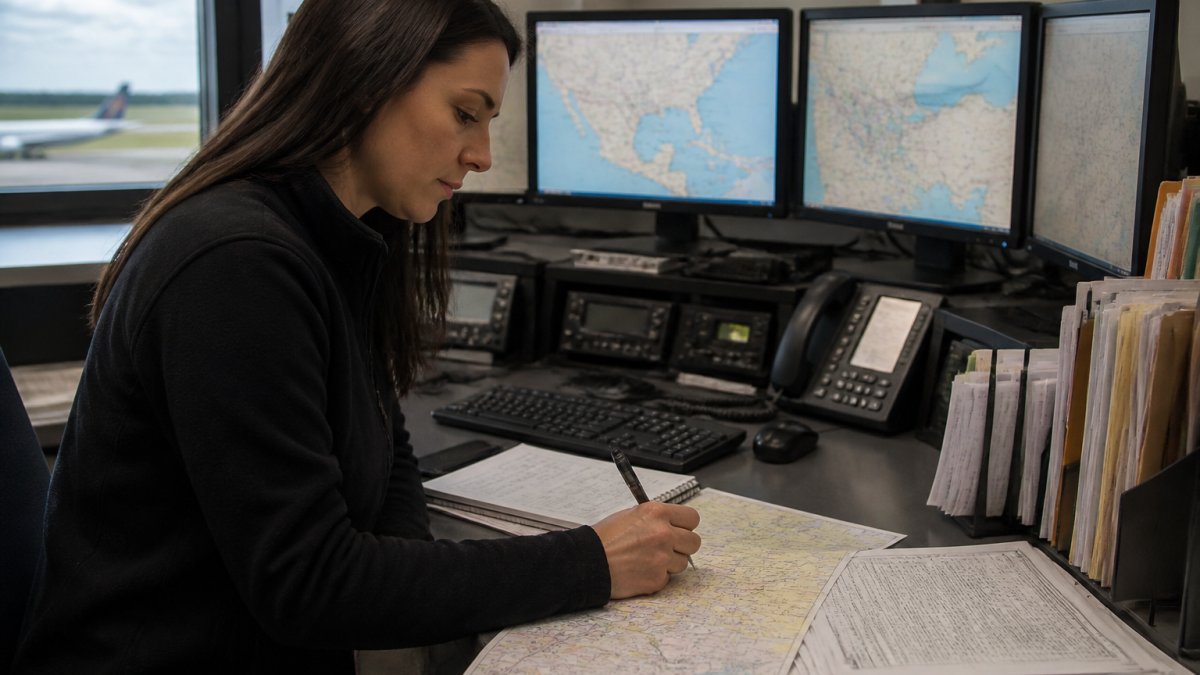
Dispatchers constantly compare actual progress to planned progress, investigating delays, recalculating fuel estimates when burn is higher than expected, and alerting crews to weather changes. Their workstations display multiple screens of weather, aircraft position, flight plan details, crew communications, and alerts.
Weather Monitoring and Forecast Updates
Weather changes hourly, so dispatchers continuously update forecasts and communicate changes to crews.
Monitoring includes:
- Destination and alternate airport weather
- En-route weather along the flight path
- Upper-level winds and jet stream positioning
- Convective weather (thunderstorms) development
- Icing and turbulence forecasts
- Visibility and ceiling trends
When weather deteriorates, the dispatcher acts quickly: alerting the crew and coordinating an alternate if the destination drops below landing minimums, requesting a different altitude or routing for severe turbulence, and confirming anti-ice systems when icing is forecast.
Aircraft Dispatcher Job Requirements and Shift Realities
Certifications, Training, and FAA Regulations
To work as a dispatcher, you must hold an FAA-issued Airline Transport Dispatcher Certificate, which requires passing the Aircraft Dispatcher examination (ADX) covering meteorology, aircraft performance, regulations, and operational decision-making.
The path to certification includes:
- 200 hours of formal instruction (FAA Part 65 requirement)
- Study of meteorology, aerodynamics, aircraft systems, and aviation regulations
- Practical training in weight and balance, flight planning, and dispatch operations
- Passing the FAA written, oral, and practical exams
QNH LLC delivers this 200-hour curriculum through FAA-approved Part 65 training. Our instructors include college professors, airline pilots, and former FAA examiners. Small class sizes mean individual attention, and the Socratic Method used by our Sheffield Graduate instructors develops the critical thinking dispatchers need daily.
Continuing education is mandatory. Dispatchers must stay current on regulatory changes, new aircraft types, and evolving operational procedures. Many airlines require annual training and proficiency checks.
Workload, Shift Patterns, and Irregular Hours
Dispatching is shift work. Airlines operate 24/7, so dispatchers work nights, weekends, and holidays on 8-10 hour shifts that can run longer when busy.
Workload varies dramatically: a slow shift might mean monitoring 10-15 flights with few issues, while a busy shift in bad weather can mean 30+ flights with constant decisions, diversions, delays, and cancellations.
The job demands:
- Quick decision-making under pressure
- Sustained focus for 8-10 hours
- Ability to manage multiple flights simultaneously
- Clear communication with crews and operations staff
- Physical stamina to sit at a workstation for extended periods
Burnout is real: the responsibility is heavy, the hours irregular, the pace relentless. But dispatchers who thrive find the work deeply rewarding, knowing their decisions keep flights safe and on schedule.
A Realistic Day in Dispatch: Hour-by-Hour Workflow
A dispatcher's day begins before the first flight departs. Here's what a typical shift looks like:
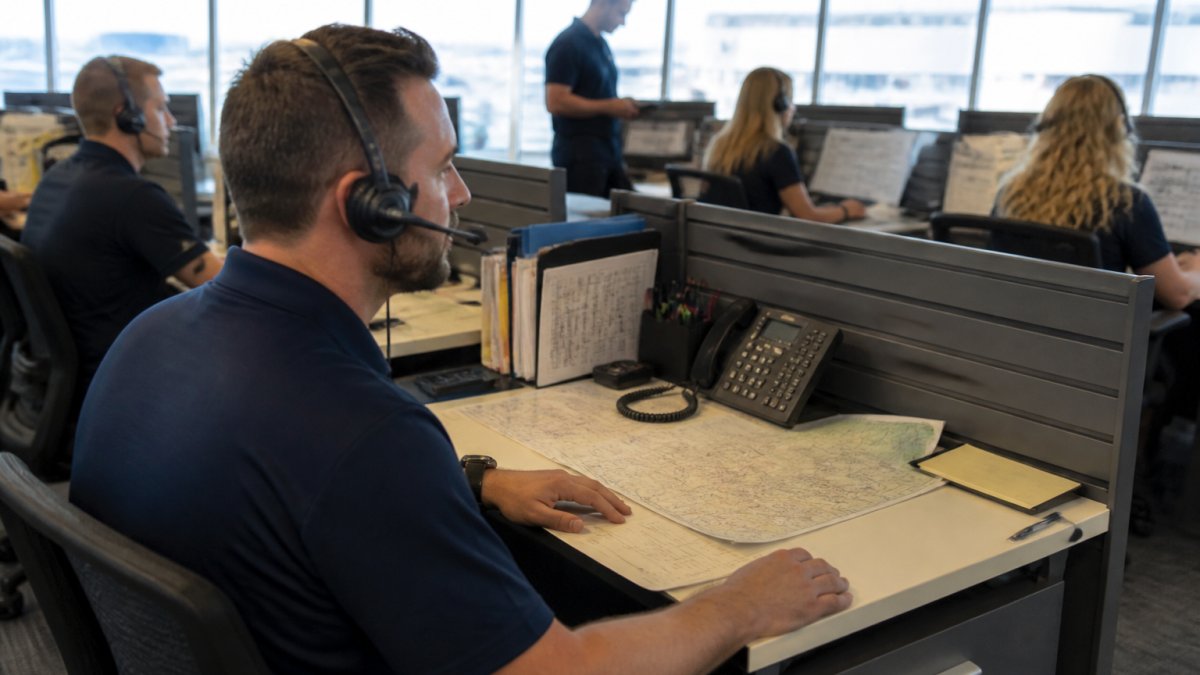
6:00 a.m., Shift begins. The dispatcher reviews overnight weather, aircraft maintenance status, and crew scheduling, checking for disruptions from the night shift that affect today's flights.
6:30 a.m., First flights begin departing. The dispatcher starts filing flight plans for morning departures.
7:00 a.m., Weather briefing. The dispatcher reviews updated National Weather Service forecasts.
8:00 a.m., Multiple flights are airborne. The dispatcher monitors their progress, tracking fuel burn, winds, and weather.
9:30 a.m., A mechanical issue reported by a crew on the ground. An engine parameter is slightly out of limits.
10:00 a.m., Destination weather deteriorates. An afternoon flight to Miami has thunderstorms forecast around its arrival time.
11:00 a.m., Crew duty-time issue.
12:00 p.m., Lunch break (if the workload allows). Many dispatchers eat at their workstation because they cannot leave during critical operations.
1:00 p.m., Peak afternoon activity. Multiple flights are in the air. The dispatcher continues monitoring weather, fuel, and progress.
2:30 p.m., The Miami weather situation develops. Thunderstorms are now forecast to be heavier than expected.
3:00 p.m., Filing evening flights. The dispatcher prepares flight plans for evening departures. Weather patterns are shifting.
4:00 p.m., A flight arrives early at its destination due to strong tailwinds. The dispatcher notes the fuel savings and updates performance data.
5:00 p.m., Shift transition. The incoming dispatcher arrives for the evening shift.
5:30 p.m., Shift ends.
Understanding the daily responsibilities of an airline flight dispatcher reveals why this role demands rigorous training and certification.
If you're considering a career in aircraft dispatch, recognize that the job is demanding but rewarding.
QNH LLC's FAA-approved Part 65 training prepares you for this reality.
Frequently Asked Questions
What exactly does a flight dispatcher do on a daily basis?
A flight dispatcher plans flights, analyzes weather, calculates fuel and loading requirements, and coordinates with pilots and crew. They monitor flights in real-time from the dispatch center, track aircraft position and status, and make operational decisions about delays, route changes, or diversions. Dispatchers also ensure compliance with FAA regulations and share responsibility with the pilot in command for flight safety and efficiency. Their work spans preflight preparation, flight release, and post-flight analysis.
What are the main aircraft dispatcher job requirements?
Dispatchers must hold an FAA Aircraft Dispatcher Certificate under Part 65 regulations, which requires passing the ADX written exam and oral examination. Most airlines require a high school diploma, strong math and English skills, and the ability to multitask under pressure. Training typically involves 200+ classroom hours covering meteorology, aerodynamics, flight planning, and aviation law. Dispatchers must also complete airline-specific training, pass medical and background checks, and maintain currency through recurrent training and proficiency checks.
How do flight dispatcher and pilot coordination work during a flight?
Dispatchers and pilots maintain continuous communication via radio, phone, or airline systems. The dispatcher provides real-time weather updates, traffic information, and operational guidance, while the pilot reports position, fuel status, and any issues. Both share responsibility for flight safety; the pilot makes final tactical decisions (altitude, speed, routing), while the dispatcher manages strategic planning and coordinates with air traffic control, maintenance, and crew scheduling. This partnership ensures safe, efficient operations even when conditions change mid-flight.
What is involved in flight dispatch flight planning before departure?
Flight planning begins with route analysis, weather assessment, and fuel calculations. Dispatchers file the flight plan with air traffic control, specifying altitude, waypoints, and alternate airports. They verify aircraft weight and balance, confirm crew availability, and check for mechanical or maintenance issues. The dispatcher then issues the dispatch release, a legal document authorizing the flight, which the pilot in command reviews and signs. This process ensures the aircraft is mechanically sound, properly loaded, and has sufficient fuel to complete the flight safely with required reserves.