 ultimate-guide
Is Flight Dispatcher Training Hard? An Honest Review
Table of Contents
- The Honest Verdict: What Makes Flight Dispatcher Training Hard
- FAA Certification Requirements and Prerequisites for Enrollment
- Flight Dispatcher Training Duration: Inside the 200-Hour Program
- Written vs. Oral and Practical Exam Difficulty
- FAA Dispatcher Knowledge Test Study Tips and Strategies
- Finding the Best FAA Approved Dispatcher Schools
- Career Reality Check: Stress, Work-Life Balance, and ROI
- Frequently Asked Questions
Last Updated: September 24, 2026
The Honest Verdict: What Makes Flight Dispatcher Training Hard
Yes, flight dispatcher training is hard, but not for the reason most people assume. The difficulty comes from volume and precision, not impossible concepts. FAA certification demands you master aviation weather, flight planning, aerodynamics, federal aviation regulations, and navigation well enough to defend a flight release before an examiner.
This guide from QNH LLC breaks down where the difficulty lives: the 200-hour program, exam difficulty, study strategies, and an honest career reality check.
The core tension: training compresses years of aviation knowledge into months. The material is learnable; the pace breaks people.
FAA Certification Requirements and Prerequisites for Enrollment
The FAA requires dispatcher candidates to be at least 23, hold a high school diploma or equivalent, read and speak English fluently, and pass a knowledge test before certification. Prior aviation experience helps but isn't required.
Prerequisites for enrollment at an FAA-approved Part 65 school are straightforward:
- Age 23 minimum at certification
- High school diploma or equivalent
- Fluent English (read, speak, write)
- Ability to pass the FAA written test
- No specific math or science degree required
The [FAA Part 65 regulations on aircraft dispatcher(/is-aircraft-dispatcher-training-worth-it) certification | faa.gov] outline these requirements in full. What most guides miss: the age rule applies at certification, not enrollment, so you can start training before your 23rd birthday.
Flight Dispatcher Training Duration: Inside the 200-Hour Program
The FAA mandates a minimum of 200 hours of approved instruction for aircraft dispatcher certification. This is the flight dispatcher training duration you should plan around.
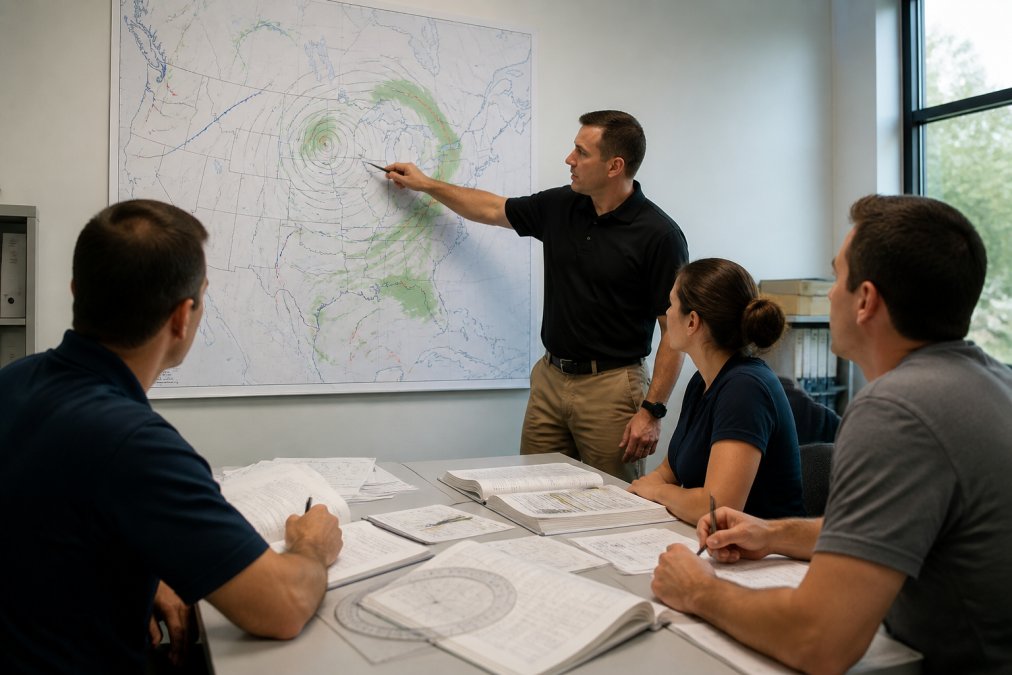
The 200-hour program divides roughly into:
| Subject Area | Approx. Hours | Why It's Demanding |
|---|---|---|
| Meteorology | 40-50 | Weather interpretation under time pressure |
| Flight planning | 35-45 | Route, fuel, and alternate calculations |
| Aerodynamics | 20-25 | Performance and weight and balance |
| Federal aviation regulations | 25-30 | Regulatory compliance and operational control |
| Navigation and ATC | 25-35 | Air traffic control procedures and charts |
| Practical application | 20-30 | Flight release scenarios and pre-flight briefing |
A common mistake is treating ground school as passive listening. Students who struggle rarely practice dispatch releases on their own.
Written vs. Oral and Practical Exam Difficulty
The written test is a knowledge check; the oral and practical exam is a judgment test. Most candidates find the oral harder because it requires defending a flight plan in real time, not recalling facts. Knowing which one may trip you up changes how you study.
The written knowledge test (ADX)
The FAA dispatcher knowledge test, the ADX, is a computer-based, multiple-choice exam at an approved Airman Knowledge Testing center. You can sit for it year-round and must pass it before being issued a dispatcher certificate. The question bank leans heavily on:
- Meteorology (weather theory, decoding METARs and TAFs, interpreting charts)
- Flight planning (fuel requirements, alternates, route selection)
- Federal aviation regulations (Part 121 operational control, Part 65 certification)
- Navigation and ATC procedures
- Aircraft performance, weight and balance
The written test rewards recall and pattern recognition. Candidates usually fail because they memorized answers instead of understanding the underlying rule, the FAA rephrases questions, so a memorized answer key falls apart on test day.
The oral and practical exam
The oral and practical is administered one-on-one by an FAA-designated examiner. You're placed in the dispatcher's seat with a real-world scenario: build a flight release for a specific city pair, day, and weather, then defend every decision, fuel load, alternate selection, routing, and in-flight deviations. The examiner wants evidence you can exercise operational control under pressure, not a textbook answer.
- Communication under questioning. Candidates who know the material but freeze when asked "why did you choose that alternate?" fail. The examiner tests whether you can justify a safety-critical decision in plain language.
- Weather interpretation in real time. Reading a forecast on a page is one skill; reading it while an examiner asks follow-ups is another. This is the most common subject-area failure.
- Weight and balance and fuel math. These are the most-failed computational sections. If you cannot run a weight and balance or compute fuel reserves without notes, you will run out of time and confidence.
Which is harder?
For most candidates, the oral and practical is harder, not because the content is more advanced, but because it's performance-based. Follow-up questions expose shallow understanding fast. The written test is a hurdle; the oral is the gate.
Study techniques for the sections people actually fail
What works:
- Weather: Redraw a surface analysis chart from memory, then compare it to the real chart. Do this daily until you identify fronts, pressure systems, and hazardous weather without hesitation.
- Aviation math: Drill weight and balance and fuel computations until automatic. Use a stopwatch. The goal is accuracy and speed under pressure.
- Oral defense: Have a study partner play examiner. Hand them a scenario and justify every choice out loud. If you cannot explain it in 60 seconds, you do not know it well enough.
- Regulations: Do not memorize Part 121 as a list. Learn the why behind operational control rules so you can reason through an unseen question.
FAA testing standards and Airman Knowledge Testing guidance confirms the knowledge test is computer-based and available year-round at approved centers.
FAA Dispatcher Knowledge Test Study Tips and Strategies
The best FAA dispatcher knowledge test study tips start with structure: short, focused blocks, real flight plans, and drilling aviation math until it's automatic. Retention comes from application, not rereading.
Study techniques that work for this material:
- Build a daily study schedule with fixed blocks for weather, regs, and math
- Practice weight and balance computations until you can do them without notes
- Redraw weather charts from memory, then check against real data
- Explain flight release decisions out loud to a study partner
- Take timed practice tests weekly to build exam stamina
Finding the Best FAA Approved Dispatcher Schools
The best FAA approved dispatcher schools share three traits: Part 65 approval, instructors with real operational experience, and small classes that allow individual attention.
When comparing programs, weigh these factors:
- FAA Part 65 approval (non-negotiable)
- Instructor background (airline pilots, former FAA examiners)
- Class size and individual attention
- Practical training in weight and balance and flight release
- Total cost and what's included
Career Reality Check: Stress, Work-Life Balance, and ROI
What prospective dispatchers need is a structured look at what the first year costs, what it pays, and what the work feels like once the certificate is in hand.
The stress is structural, not incidental
- Shift structure. Most airline dispatcher roles run on rotating shifts, including nights, weekends, and holidays. Seniority determines which shifts you get; new hires start on the least desirable schedules.
- Operational tempo. Weather events, mechanical issues, and ATC ground stops create bursts of high-intensity decision-making. Between those bursts, the work can be routine.
- Team structure. Dispatchers work in operations centers alongside other dispatchers, meteorologists, and flight followers. The culture of the shop matters as much as the airline.
- Training cost. FAA-approved Part 65 dispatcher programs vary widely in price. Some are standalone certificate programs; others are bundled with associate degrees. Cost depends on format, location, and housing.
- Time cost. A full-time program runs 5-7 weeks, 5-7 weeks of not earning a full-time wage, plus tuition. Part-time programs stretch the cost over months.
- Starting pay. Regional airline dispatcher pay is lower than major airline pay. Regional starting compensation is modest; majors pay substantially more but usually hire experienced dispatchers.
- Progression. Pay scales up with seniority and moves to larger carriers. Dispatchers who transition to operations management, training, or regulatory roles can see further increases.
Post-certification reality check
- You will be slow. A release that took 20 minutes in school may take longer under real operational pressure, with real weather and time constraints.
- You will make mistakes. The difference between a good dispatcher and a bad one is not error-free performance, it is how quickly you catch and correct errors, and whether you ask for help.
- Hiring is competitive. The certificate opens doors, but getting hired depends on interview performance, technical proficiency, willingness to relocate, and willingness to work nights and holidays.
- The learning curve is steep for 6-12 months. Most dispatchers say the job does not feel routine until well into the first year.
Is the career worth the training effort?
Frequently Asked Questions
How hard is it to become an airline dispatcher?
It is challenging but achievable with the right preparation. The hardest parts are the 200-hour curriculum, the FAA written test, and the oral and practical exam where you defend a flight plan. Students who treat training like a full-time job, attend every class, and review aviation weather and regulations daily are well-prepared. Small class sizes and instructor feedback can aid in understanding the material.
Do I need a background in aviation to pass dispatcher training?
No. You will learn meteorology, aerodynamics, federal aviation regulations, navigation, and flight planning from the ground up. The key is choosing a program that gives you individual attention, especially if math or weather theory is new to you.
How much study time is required for the FAA dispatcher knowledge exam?
That includes reviewing ground school material, practicing weight and balance problems, and memorizing regulations. Many programs include a Gleim Online Ground School course to reinforce classroom instruction.
Is the aircraft dispatcher practical exam difficult to pass?
An FAA examiner gives you a scenario and you must build a flight plan, analyze weather, calculate weight and balance, and justify every decision out loud. It is not a memorization test. Students who practiced defending their choices in class, not just answering multiple-choice questions, are well-prepared.
What makes a successful student in an FAA-approved dispatcher program?
Successful students show up prepared, ask questions in class, and practice explaining their reasoning out loud. They treat weather, regulations, and math as skills to drill, not facts to memorize. They also choose programs with small classes and instructors who have real airline or FAA examiner experience, as that feedback is valuable for developing the judgment an examiner is looking for.