 ultimate-guide
Aircraft Dispatcher Math and Physics Requirements
Last Updated: October 23, 2026
Quick Summary
The FAA sets no standalone math or physics prerequisite for aircraft dispatcher certification. Instead, dispatcher math and physics appear on the ADX knowledge test and practical exam, where you must demonstrate competency in time-speed-distance, fuel planning, weight and balance, and performance chart interpretation. Training providers and airlines may add their own criteria on top of the federal rules.
- Applicants must be at least 23 years old and hold a high school diploma or equivalent.
- The ADX written test covers flight planning, meteorology, regulations, and aircraft performance, each involving calculation.
- Dispatcher calculations sit at the level of practical arithmetic, ratios, percentages, and basic algebra.
- In the sample leg, trip fuel of 7,800 pounds plus contingency, alternate, and reserve totals 11,580 pounds.
- QNH LLC's program includes 200 classroom hours taught partly by former FAA Dispatcher Examiners.
Table of Contents
- What the FAA Actually Requires for Dispatcher Math and Physics
- Aircraft Dispatcher Requirements: Eligibility, Certification, and Where Math Fits
- The Math You Use on the Job: Time-Speed-Distance, Fuel, and Unit Conversion
- Aircraft Dispatcher Course Subjects That Depend on Math and Physics
- Aviation Weather Calculations: Pressure, Temperature, and Wind
- Aircraft Weight and Balance Calculations in Dispatcher Training
- How Hard Is the Math, and How to Prepare Without a Strong Background
- Conclusion
- Frequently Asked Questions
What the FAA Actually Requires for Dispatcher Math and Physics
Here's the answer most guides bury: the FAA sets no standalone math or physics prerequisite for aircraft dispatcher certification. There is no "must have completed calculus" line in the rulebook. The FAA regulations governing aircraft dispatchers, 14 CFR Part 65 define the certificate through knowledge and experience requirements rather than course prerequisites, and that distinction changes how you should prepare.
Aircraft Dispatcher Requirements: Eligibility, Certification, and Where Math Fits
Aircraft dispatcher requirements center on age, experience or training, and a set of written, oral, and practical tests. The FAA's guidance on dispatcher certification and testing confirms the certificate is earned through demonstrated knowledge rather than a math course.
Where people get confused is the difference between training, certification, and hiring. These are four separate gates, and each one treats math and physics differently:
- School admission. Individual training providers set their own entry criteria. Some require a high school diploma or equivalent; a few may recommend algebra or physics refreshers, but these are institutional preferences, not federal rules. Always check the specific program's admissions page rather than assuming a universal standard.
- FAA certificate eligibility. Under 14 CFR Part 65, the FAA requires a high school diploma or equivalent (or certain experience substitutions) and a passing score on the knowledge test, but it does not mandate a standalone math or physics course. The regulation tests applied competency, not transcripts.
- Exam content. The ADX knowledge test and the practical/oral exam do require calculation: time-speed-distance, fuel planning, weight and balance, and performance chart interpretation. This is where math and physics actually live in the certification path.
- Airline hiring. Employers may add their own assessments, interviews, or simulator-based evaluations. A certificate proves you passed the FAA's bar; an airline's hiring process may test your calculation speed and judgment under operational pressure.
A common pattern is for applicants to conflate a school's recommended background with an FAA mandate. The FAA regulations governing aircraft dispatchers, 14 CFR Part 65 are the authoritative source for eligibility; training providers and airlines layer their own criteria on top.
The Math You Use on the Job: Time-Speed-Distance, Fuel, and Unit Conversion
Dispatcher math on the line is arithmetic and algebra applied under time pressure, not abstract theory. The core operations are time-speed-distance problems, fuel burn and reserve calculations, and unit conversions between pounds, kilograms, gallons, liters, feet, and meters. The FAA's Pilot's Handbook of Aeronautical Knowledge lays out the same time-speed-distance and fuel planning fundamentals that dispatchers apply on a larger scale. If you want a deeper walkthrough of reserve fuel, our guide on how to calculate fuel reserves for long haul flights works through the actual computations.
Aircraft Dispatcher Course Subjects That Depend on Math and Physics
An aircraft dispatcher course subjects list reads like a math syllabus in disguise. Meteorology depends on pressure, temperature, and wind relationships. Aircraft performance depends on density altitude, thrust, and drag. Weight and balance is pure arithmetic and algebra. Navigation depends on course, heading, and wind correction angles. Aviation regulations require you to interpret limits that are themselves numbers. At QNH LLC, our 200 classroom hours build these subjects together so the calculations reinforce each other rather than sitting in isolation.
Aviation Weather Calculations: Pressure, Temperature, and Wind
Aviation weather calculations turn a forecast into a decision. Dispatchers work with pressure altimetry, temperature conversions, dew point spreads, and wind components, including headwind and crosswind calculations that affect runway choice and fuel. The National Weather Service's aviation weather resources are the reference dispatchers and pilots use for the raw data behind those calculations. Our guide on how to study aircraft dispatcher meteorology covers the study approach for this subject in more depth.
Aircraft Weight and Balance Calculations in Dispatcher Training
Aircraft weight and balance calculations are where dispatcher math becomes most concrete, and where many applicants feel the most anxiety. If you want to practice the computations on your own, our aircraft weight and balance calculation help page and the step-by-step weight and balance tutorial walk through worked problems.
How Hard Is the Math, and How to Prepare Without a Strong Background
The math is not hard in the abstract; it is demanding in application. Dispatcher calculations sit at the level of practical arithmetic, ratios, percentages, and basic algebra. The difficulty comes from speed, accuracy, and the stakes attached to each answer, not from advanced mathematics. To make that concrete, here is a representative problem of the kind you will see in training and on the ADX:
Sample problem: fuel required for a leg. An aircraft burns 2,400 pounds of fuel per hour. The leg time is 3 hours 15 minutes. Trip fuel is 2,400 × 3.25 = 7,800 pounds. Add a 10% contingency (780 pounds), an alternate allowance of 1,200 pounds, and a 45-minute reserve (2,400 × 0.75 = 1,800 pounds). Total fuel required is 7,800 + 780 + 1,200 + 1,800 = 11,580 pounds. Convert to gallons using the fuel's weight per gallon, and you have the figure that goes on the release. Every step is arithmetic; the challenge is doing it accurately, in sequence, under time pressure. Mastering these calculations requires consistent practice, and utilizing professional certification tools helps ensure that your flight planning remains precise and reliable throughout the examination process.
Sample problem: weight and balance. Zero fuel weight is 8,500 pounds. Fuel loaded is 2,000 pounds. Takeoff weight is 10,500 pounds, which must not exceed maximum takeoff weight.
Sample problem: time-speed-distance with wind. True airspeed is 420 knots, headwind component is 35 knots, and distance is 630 nautical miles. Ground speed is 385 knots, so leg time is 630 ÷ 385 ≈ 1.64 hours, or about 1 hour 38 minutes.
If you struggled with math in school, the fix is structured repetition with someone who can catch your errors early. A practical preparation plan looks like this:
- Refresh arithmetic and fractions. Practice multiplication, division, ratios, and unit conversions until they are automatic. Ten to fifteen minutes a day for a few weeks is usually enough to rebuild fluency.
- Drill time-speed-distance and fuel problems. Work the same problem types repeatedly with changing numbers, checking each answer against a calculator.
- Learn the weight and balance method step by step. Compute zero fuel weight, add fuel, check maximum weights, then compute moments and center of gravity. Repeat until the sequence is habit.
- Practice reading performance charts. Understand how density altitude, temperature, and weight affect takeoff and climb performance before you plug in numbers.
- Take practice knowledge tests under timed conditions. Speed and accuracy improve with realistic rehearsal.
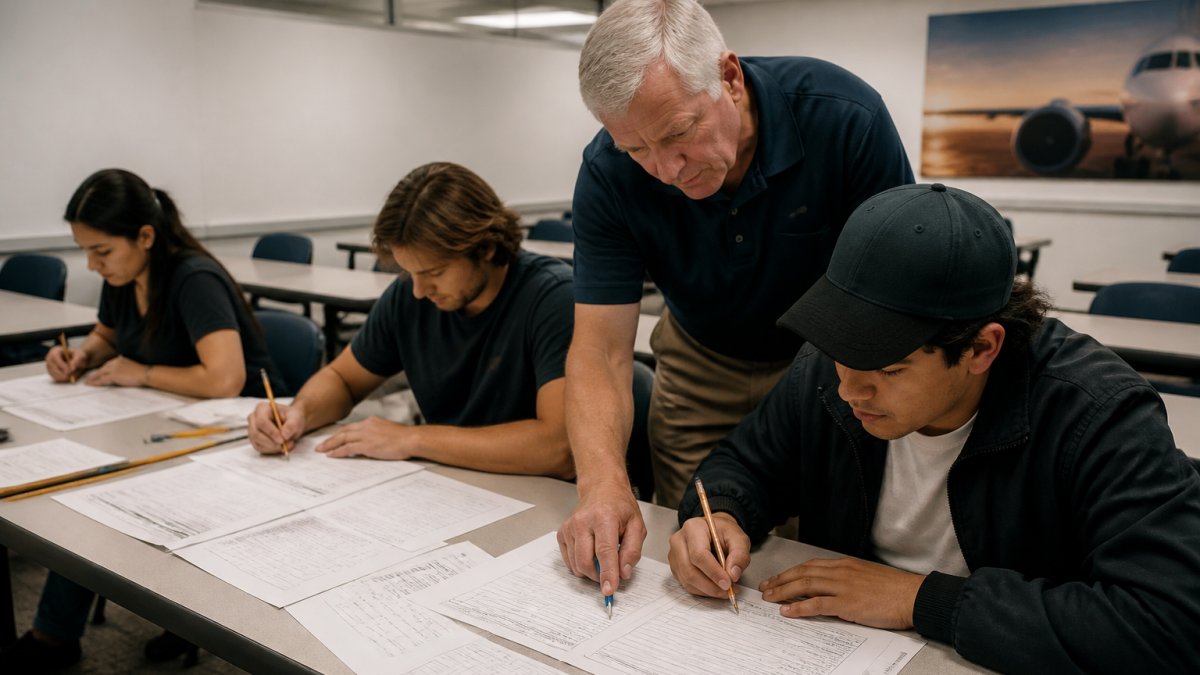
That is the case for small-class instruction: an instructor who sees your load sheet can correct a habit before it becomes a test failure. If you're weighing whether the program is for you, our guide on whether aircraft dispatcher training is hard gives an honest look at the workload.
Here are the sample calculations the article walks through, with their given figures and results.
| Problem | Given figures | Result |
|---|---|---|
| Fuel for a leg | 2,400 lb/hr burn; 3 hr 15 min leg | Trip fuel 7,800 lb |
| Contingency and reserve | 10% contingency; 45-min reserve | 780 lb contingency; 1,800 lb reserve |
| Total fuel required | Trip, contingency, alternate, reserve | 11,580 lb |
| Weight and balance | Zero fuel weight 8,500 lb; fuel 2,000 lb | Takeoff weight 10,500 lb |
| Time-speed-distance with wind | 420 kt TAS; 35 kt headwind; 630 nm | 385 kt ground speed; about 1 hr 38 min |
Conclusion
The math and physics in dispatcher training aren't a gate you clear before you start; they're the working skills you build during it. If you're ready to master weight and balance, meteorology, and flight planning with instructors who've examined candidates on exactly these calculations, QNH LLC's FAA-approved Part 65 program offers small classes, 200 classroom hours, and teaching from airline pilots and former FAA Dispatcher Examiners. Reserve now and start preparing for the ADX with the calculation skills the job actually demands.
Frequently Asked Questions
How much math do you need to become an aircraft dispatcher?
You need working arithmetic, basic algebra, and comfort with time-speed-distance and unit conversions. The FAA does not require a college math course for the dispatcher certificate, but the ADX knowledge test and practical exam assume you can compute fuel burn, aircraft weight and balance, and wind corrections accurately. Most of the math is applied rather than theoretical, and a structured aircraft dispatcher course drills the specific calculations until they become routine.
Do aircraft dispatchers need to study physics?
You do not need a physics degree, but you do need practical physics concepts. Dispatchers work with aircraft performance, lift and drag, density altitude, and how temperature and pressure change takeoff and landing distances. These ideas show up in aircraft dispatcher course subjects like aerodynamics and performance, and they drive real decisions about whether a flight can legally and safely operate. A course that connects the physics to the actual dispatch release makes the material easier to apply.
What math topics are covered in aircraft dispatcher training?
Expect time-speed-distance problems, fuel planning and reserve calculations, weight and balance computations using moment and center of gravity, wind triangle and drift corrections, unit conversions between pounds and kilograms, and pressure and temperature conversions for weather analysis. The ADX test and oral exam draw on these skills. Training programs build them up from basic arithmetic so applicants without a strong math background can keep pace.
Can you become an aircraft dispatcher if you are not good at math?
Yes, provided you are willing to practice. The math in dispatch work is repetitive and formula-driven rather than abstract, so most struggles come from unfamiliarity, not inability. Small classes with individual attention help, because an instructor can catch a specific error in a weight and balance or fuel calculation and correct it immediately. Before enrolling, review fractions, percentages, ratios, and basic algebra, then let the course handle the aviation-specific applications.
What are the basic aircraft dispatcher requirements beyond math?
Applicants must be at least 23 years old, hold a high school diploma or equivalent, read, speak, and understand English, and pass the required knowledge and practical tests. Training must come from an FAA-approved Part 65 program, and applicants need the instructor endorsement to sit for the ADX knowledge test. Meeting the aircraft dispatcher requirements is mostly about completing approved training and demonstrating competency, not about a specific math or science credential.
How difficult is the ADX exam and how is math tested?
The ADX knowledge test is a broad, detailed exam covering regulations, meteorology, navigation, aircraft performance, and flight planning. A passing score is 70 percent. Math appears throughout as applied questions rather than a separate section, so you might calculate fuel required, solve a wind correction, or verify a weight and balance. The practical and oral exam then asks you to defend a flight plan, which means explaining the numbers behind your decisions, not just producing them.