 ultimate-guide
How Emerging Aviation Technology Is Reshaping Aviation Law
Last Updated: November 6, 2026
Quick Summary
Emerging aviation technology strains existing aviation law because rules were written for crewed aircraft flown by trained pilots, while drones, AI and advanced air mobility do not fit those categories. Regulators must address the new legal questions in aviation technology law, which is why operators and manufacturers should track FAA rulemaking closely.
- Regulators write rules for technology they can see, so rules often trail new developments.
- Drone operators needing more than Part 107 allows must request a waiver or exemption from the FAA.
- Manufacturers must document training data, validation methods and operational design domains for AI systems.
- Liability for autonomous system incidents may fall on the operator, manufacturer, software supplier or data provider.
- Operators should map in writing which party owns each category of flight data before an incident occurs.
Table of Contents
- Why New Aircraft Technology Strains Existing Aviation Law
- Drone Laws and Regulations Under the FAA
- Artificial Intelligence in Aviation and Certification Challenges
- Autonomous Aircraft Legal Issues and Liability Allocation
- Advanced Air Mobility Regulation and Its Open Questions
- Data Privacy, Cybersecurity and Operator Obligations
- Preparing for the Next Wave of Aviation Rules
- Frequently Asked Questions
Why New Aircraft Technology Strains Existing Aviation Law
The impact of emerging aviation technology on law, and on aviation technology law in particular, is already visible in every rulemaking docket the Federal Aviation Administration (FAA) manages. Aviation law was built around crewed aircraft flown by trained pilots, certified through established airworthiness processes. Uncrewed systems, machine-learning flight aids and advanced air mobility vehicles do not fit neatly into those categories.
The tension is structural. Regulators write rules for the technology they can see, and by the time a rule is final, the technology has often moved on. That gap creates uncertainty for operators, manufacturers, insurers and the legal practitioners who advise them. Most of the legal questions in this area of aviation technology law are not new in kind, but the speed and scale of change make old answers harder to apply.
Drone Laws and Regulations Under the FAA
A drone operator in a field checks a handheld controller while a small quadcopter hovers nearby under overcast skies. For most commercial flights, the starting point is 14 CFR Part 107, the FAA's small unmanned aircraft rule. It sets requirements for remote pilot certification, aircraft registration and operating limits such as daytime flight and visual line of sight.
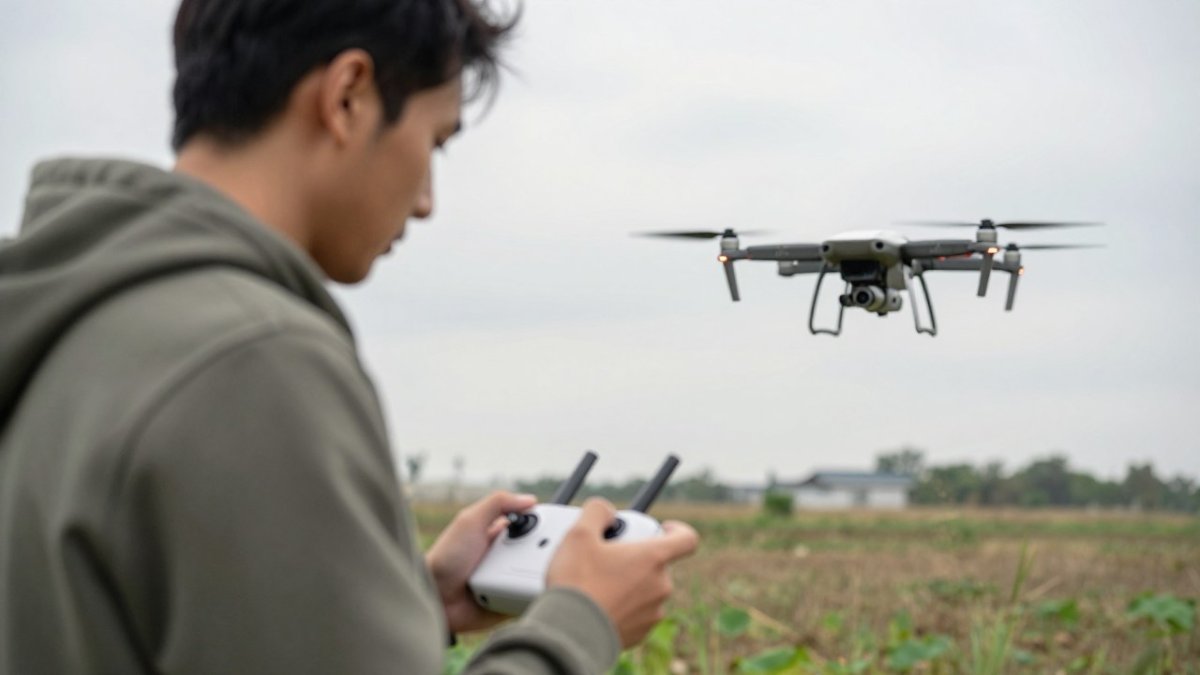
Operators who need more than Part 107 allows must request a waiver or exemption. The FAA reviews these case by case, so an operator planning a novel mission should expect to document its safety reasoning. Drone rules also interact with state and local restrictions, which can add a second layer of compliance to the federal one.
Part 107 and Beyond Visual Line of Sight Waivers
Beyond visual line of sight (BVLOS) operations are the clearest example of technology outrunning the default rules.
Artificial Intelligence in Aviation and Certification Challenges
Artificial intelligence raises a certification problem that aviation regulators have not fully solved, and the legal impact shows up in how manufacturers must document and defend the behavior of systems whose outputs are not fully predetermined. Traditional airworthiness certification assumes a system's behavior can be fully specified and tested against that specification. Machine-learning components behave differently: their outputs depend on training data, and their behavior in unfamiliar conditions can be hard to predict, which strains the evidentiary assumptions built into the FAA's certification processes.
A useful way to see where the law bites is to compare AI against other emerging technologies by the legal issue each one triggers. AI's distinctive legal problem is assurance and explainability, how a manufacturer evidences that a learned model is safe across its intended operating domain. Autonomous aircraft raise allocation-of-responsibility questions when a system acts without a pilot in the loop. Drones raise airspace integration and waiver questions. Advanced air mobility raises novel aircraft certification and local land-use questions. Digital twins raise data integrity and recordkeeping questions. Blockchain-based maintenance records raise evidentiary and retention questions. The rules differ by technology because the underlying legal risk differs, and a manufacturer that treats them as one compliance problem will misallocate its assurance effort.
In practice, that means documenting training data provenance and coverage, validation and verification methods, the operational design domain within which the system is intended to function, and the monitoring and fallback arrangements when the system encounters conditions outside that domain.
A common pattern is that manufacturers underestimate the documentation burden. A model that performs well in testing can still fail a regulator's review if the manufacturer cannot show why it performs well, what data it was trained on, and how it behaves at the edges of its intended use. The legal consequence is delay: certification timelines stretch when assurance evidence is assembled after the design is frozen rather than alongside it.
Watch out: treating AI assurance as an engineering task alone, without legal review of the safety case and the representations made to the regulator, can create exposure if an incident later calls those representations into question.
For manufacturers, the open question is how much assurance a regulator will accept before a system is allowed into operational service, and that answer is likely to vary by the criticality of the function the AI performs. A system that advises a pilot is held to a different standard than one that makes control decisions, and the legal analysis should follow that distinction rather than treating all AI as equivalent. That same function-based approach matters when AI for legal drafting shapes the evidence and reasoning used to demonstrate that a system meets its required level of assurance.
Autonomous Aircraft Legal Issues and Liability Allocation
When an autonomous system contributes to an incident, liability is harder to assign than in a conventional accident. Responsibility may fall on the operator, the manufacturer, the software supplier or the data provider, and the contracts between them often determine the outcome before a court does.
Watch out: contracts that assign all risk to the operator can leave a small operator uninsured for failures it had no ability to prevent.
Incident Scenarios and Insurance Exposure
Consider a delivery drone that strikes a power line because its obstacle-detection model misclassified the line in poor light. The operator may argue the software failed, the manufacturer may point to the operator's mission planning, and the insurer may question whether the flight stayed within its approved envelope. Each party's policy and contract language will shape the result, which is why operators should review their coverage against the specific technology they use.
Advanced Air Mobility Regulation and Its Open Questions
Advanced air mobility (AAM) covers electric vertical takeoff aircraft and related services intended for urban and regional passenger or cargo use. The FAA has begun establishing a framework for these vehicles, but many operational questions remain open, including vertiport design, air traffic integration and the certification path for novel powered-lift aircraft.
Local governments also have a stake, because vertiport siting and noise rules fall under their authority. Expect regulatory coordination between federal and local bodies to be a recurring source of delay and negotiation.
Data Privacy, Cybersecurity and Operator Obligations
Modern aircraft generate large volumes of operational, location, and sensor data, and connected systems create new attack surfaces that aviation law is only beginning to address in detail. Most treatments of this topic stop at a general privacy reference, but the practical legal questions are more specific: who owns the data, what consent is required, how long it may be retained, what happens after a breach, and what transparency is owed about how automated systems use that data.
Data ownership is the first unresolved question. Flight data may be generated by the operator, the aircraft manufacturer, a software provider, or a third-party service, and the contracts among them often determine ownership and access before any regulator does. Operators should map, in writing, which party owns each data category, who may access it, and under what conditions, because a dispute after an incident is a poor time to discover the answer.
Consent and privacy obligations arise when sensors capture images of people or property on the ground. Federal privacy law is sector-specific rather than comprehensive, so the applicable obligations depend on the operator's activities and on state law, which can add requirements beyond the federal baseline. Operators conducting sustained surveillance-type missions should treat privacy impact assessment as a compliance step, not an afterthought.
Retention and breach response are where legal exposure concentrates. A documented retention schedule limits both privacy risk and discovery burden, and a breach response plan should identify who notifies whom, on what timeline, and with what records. Cybersecurity is increasingly part of airworthiness and operational approval rather than a separate IT concern, and operators should treat data governance as a compliance item with named owners and documented controls.
Algorithmic transparency is the newest obligation and the least settled. When an automated system contributes to a decision, regulators and litigants will want to know what the system was designed to do, what data it used, and what human oversight existed. Operators and manufacturers should document those answers before an incident forces the question.
A useful comparison across technologies clarifies where the obligations differ. Drones raise location-data and imagery-privacy questions most acutely because they operate close to people and property. Advanced air mobility raises passenger-data and vertiport-surveillance questions. AI raises transparency and explainability questions. Digital twins raise data-integrity and recordkeeping questions. Blockchain-based records raise retention and evidentiary questions.
Watch out: assuming that a vendor's security certification transfers to the operator's own compliance obligations can leave the operator exposed when a breach originates in a system the operator controls but did not secure.
The article compares how each emerging technology creates a different data-related legal obligation, summarised below.
| Technology | Core data or legal issue | Key concern |
|---|---|---|
| Drones | Location data and imagery privacy | Operation close to people and property |
| Advanced air mobility | Passenger data and vertiport surveillance | Passenger and site-level data use |
| AI | Transparency and explainability | What the system does and how it decides |
| Digital twins | Data integrity and recordkeeping | Accuracy and retention of operational records |
| Blockchain-based records | Retention and evidentiary questions | Whether records hold up as evidence over time |
Preparing for the Next Wave of Aviation Rules
Operators, manufacturers and aviation professionals can prepare by tracking FAA rulemaking dockets and building safety cases before they are required. Current standards and dispatch requirements are summarized in FAA aviation regulations overview, and a broader study guide on aviation law and regulations is available on our site, covering aviation law and regulations. Readers planning a career in this field may also want to review what FAA Part 65 certification involves, and the long-term demand outlook for flight dispatchers.
Maintaining credentials over time matters as rules change, so our guidance on how to maintain your aircraft dispatcher certificate covers ongoing obligations. Understanding human factors is also central to safe operations, which is why CRM training is essential for aircraft dispatchers is a topic every candidate should understand.
For operators and students alike, the path forward is clear: follow the rulemaking, document your safety reasoning, and build legal literacy into your technical training. Reserve now with QNH LLC to build those foundations with small-class instruction and experienced instructors.
Frequently Asked Questions
How does new technology affect aviation law?
New aircraft technology strains rules written for crewed aircraft. The FAA and Congress must decide how existing certification, operating and airspace rules apply to uncrewed systems, automated functions and new vehicle types. Regulators typically respond through rulemaking, exemptions and waivers, which can take years. Operators in the meantime must track both current rules and proposed changes, since compliance obligations shift as agencies finalize new standards for these technologies.
How are drones regulated under U.S. aviation law?
The FAA regulates drones under Title 14 of the Code of Federal Regulations. Most commercial operators fly under Part 107, which requires a remote pilot certificate, registration and operation within set limits such as altitude and visual line of sight. Operations beyond those limits generally need a waiver or exemption. Operators should review the current FAA requirements before each new type of flight, because waiver conditions vary by operation.
Who is legally responsible when an automated aircraft causes an accident?
Responsibility depends on the facts. Liability may fall on the operator, the manufacturer, a software developer or a maintenance provider, and courts often apply negligence or product liability theories. Insurance terms and contracts between parties also shape who pays. Because few cases have tested these questions for highly automated aircraft, outcomes remain uncertain, and operators should review their policies and contracts with counsel.
What legal issues do advanced air mobility aircraft create?
Advanced air mobility aircraft raise questions about airworthiness certification, pilot or remote operator qualifications, urban airspace use, noise and community impact, and integration with existing air traffic control. Regulators are still developing the operating framework, so companies planning these services should monitor FAA rulemaking and any new certification pathways that apply to their vehicle type and planned routes.