 listicle
Dispatcher Training with Job Placement Help: 2026 Guide
Table of Contents
- What Dispatcher Training with Job Placement Help Actually Includes
- How Long Is Aircraft Dispatcher Training?
- FAA Part 65 Aircraft Dispatcher Certification: What It Covers
- Entry-Level Aircraft Dispatcher Jobs: Where Graduates Land
- How to Vet Job Placement Claims Before You Enroll
- Post-Training Mentorship and the Technical Stack You Need
- Conclusion
- Frequently Asked Questions
Last Updated: September 11, 2026
What Dispatcher Training with Job Placement Help Actually Includes
Dispatcher training with job placement help combines FAA-required classroom instruction with career services that connect graduates to hiring airlines and operators. At QNH LLC, that means a 200-classroom-hour program: technical instruction first, then placement support.
Classroom Hours vs. Online Modules
Classroom instruction gives you something online modules cannot: an instructor who stops you mid-mistake. The FAA requires 200 hours of approved instruction, and how a school delivers those hours shapes your readiness (ecfr.gov).
Online modules work for self-motivated learners with aviation backgrounds. For everyone else, weight and balance computations, meteorology interpretation, and flight plan defense are skills built through repetition with someone correcting you in real time.
At QNH LLC, classes stay small on purpose. Instructors include airline pilots and former FAA Dispatcher Examiners, and the Socratic Method means you defend your reasoning out loud long before facing an examiner.
What Job Placement Help Means in Practice
Job placement help is the career support a school provides after graduation, ranging from genuine industry connections to a job board list you could have found yourself.
Ask what actually happens after you pass. A real placement program includes aviation-specific resume review, interview preparation with people who know airline hiring, and introductions to operators actively recruiting. A weak one sends a congratulations email and a link.
How Long Is Aircraft Dispatcher Training?
Aircraft dispatcher training typically runs 200 classroom hours over six to eight weeks full-time, or longer part-time. That figure is not a school's marketing choice, it is the FAA minimum for approved dispatcher certification programs.
Part-time formats stretch the same curriculum across several months, a route working airline employees often choose. The trade-off is momentum: flight planning and weather analysis sharpen through frequent practice, and long gaps slow it.
For career changers from outside aviation, the full-time schedule usually produces better results. Immersion builds the pattern recognition needed to read a weather system or catch a fuel error quickly.
FAA Part 65 Aircraft Dispatcher Certification: What It Covers
FAA Part 65 aircraft dispatcher certification is the regulatory standard that governs who may legally dispatch flights under Part 121 airline operations, and it defines both the training curriculum and the exams you must pass. The certification lives in the FAA's Part 65 regulations, which spell out eligibility, knowledge requirements, and testing.
The curriculum covers four core areas:
- Meteorology: weather theory, forecasting, and interpreting reports well enough to make go/no-go calls
- Aerodynamics and aircraft performance: how weight, altitude, and temperature affect what an aircraft can safely do
- Aviation law and regulations: the operating rules that govern commercial flight
- Practical dispatch: weight and balance computations, flight planning, and dispatch release preparation
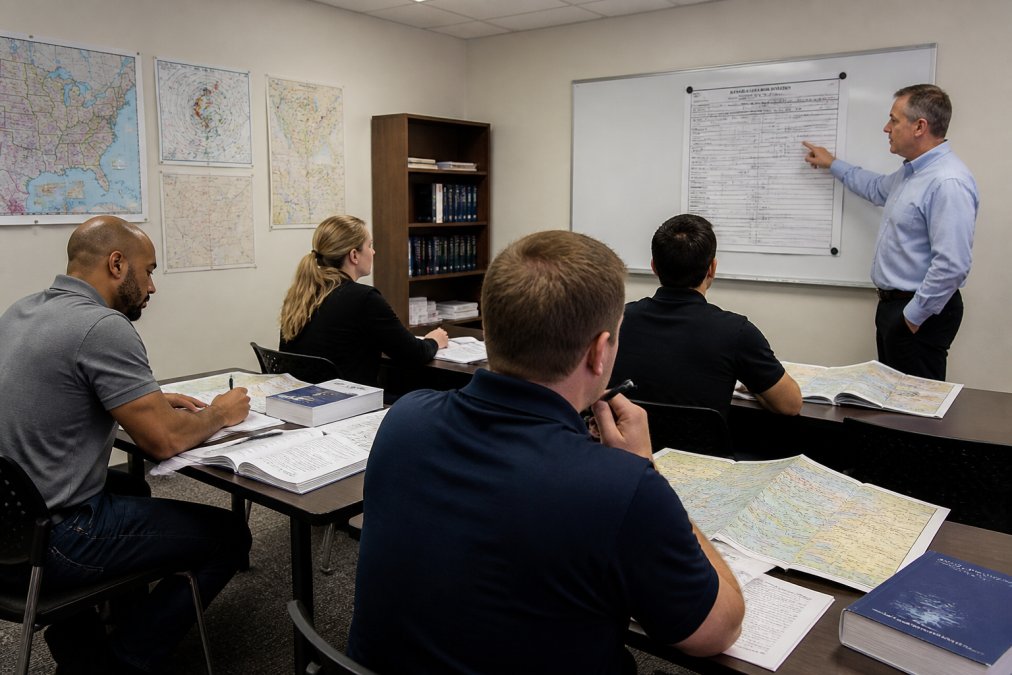
Written, Oral, and Practical Exam Requirements
Certification requires passing a written knowledge test, an oral exam, and a practical test. The written exam covers the regulatory and technical knowledge base. The oral and practical portions are where candidates separate: an examiner hands you a scenario and expects you to defend a flight plan, not just recall facts.
This is why 200 hours of passive lecture attendance does not prepare you. You need reps defending decisions out loud. QNH LLC's instructors, including former FAA Dispatcher Examiners, run students through that continuously rather than saving it for a final review week.
Entry-Level Aircraft Dispatcher Jobs: Where Graduates Land
Entry-level aircraft dispatcher jobs cluster in three employer types: airlines, cargo carriers, and charter operations. Each hires differently, and knowing the difference shapes where you apply first.
Airlines run structured hiring pipelines and often recruit before you graduate. Cargo carriers operate around the clock, meaning more openings and more willingness to hire candidates without airline experience. Charter operations hire in smaller numbers but often take a chance on a new certificate holder who interviews well.
The practical difference matters for your first job search. A candidate who only applies to major airlines may wait months. One who applies across all three categories usually starts working sooner and builds seniority faster.
How to Vet Job Placement Claims Before You Enroll
Most training providers promise placement; almost none define it. That gap is where enrollments go wrong, so treat this section as a buyer's checklist rather than a sales pitch, including for the program this article comes from.
Separate the three things schools blur together:
- Job placement means the school actively puts you in front of a hiring manager, a named coordinator making introductions, submitting your resume, and following up until you have an offer or a documented reason you do not.
- Job assistance means the school helps you help yourself: resume review, mock interviews, alumni referrals, and access to a job board.
- Job leads means a list of openings you could have found on your own.
All three get marketed as "placement help." Only the first two change your odds. Ask which one is in the contract.
The Red Flags That Show Up Most Often
A common pattern is the placement guarantee that is technically true and practically empty. Watch for these:
- "Guaranteed placement" with no written remedy. A guarantee is only as good as the consequence attached to it. If the school does not get you hired, what happens, tuition refund, free retraining, continued job-search support for a defined period? If the answer is "we'll keep helping," that is not a guarantee, it is a promise to try.
- Placement rates with no denominator. "95% placement" means nothing without knowing how many graduates, over what period, in what roles, and whether part-time or contract gigs are counted. Ask for the last three cohorts specifically.
- No named placement contact. A real program has a person with a title, a phone number, and aviation industry relationships. "Career services" as a shared inbox is a red flag.
- Placement counted before hire. Some schools count "interviews arranged" or "resumes forwarded" as placements. Ask what event triggers the placement count.
- Upfront payment with no refund window. Legitimate programs let you withdraw in the first days of class. If all tuition is non-refundable on day one, the school has no financial incentive to place you.
- Pressure to enroll now. Cohort scarcity is real in small programs, but a school that will not let you take the contract home overnight is selling, not advising.
Questions That Produce Useful Answers
Vague questions get vague answers. These force specifics:
- "How many students graduated in the last three cohorts, and how many are working as dispatchers today?"
- "Can you introduce me to two graduates from the last year who are currently on a desk?"
- "Who is the placement coordinator, and how many active hiring relationships do they maintain?"
- "What is the refund or retraining policy if I complete the program and do not get hired within six months?"
- "Which employers hired from your last class, and in what roles?"
A school with real results answers these without hesitation. One that stalls, deflects to "our reputation speaks for itself," or offers to "discuss it after you enroll" is telling you what you need to know.
Verify What You Can Independently
You do not have to take any school's word for it. A few free checks:
- Search the school and its owners for complaints with your state attorney general's office and the Better Business Bureau. Consumer protection actions against vocational schools are public record.
- Check accreditation claims. If a program advertises accreditation, confirm it with the accrediting body directly rather than the school's website.
- Confirm FAA approval status. Dispatcher certification programs must be approved under 14 CFR Part 65. Ask for the approval and verify it.
- Talk to working dispatchers. Ask on industry forums or LinkedIn what they know about the program. Practitioners are blunt about which schools produce hireable graduates.
- Read the enrollment agreement line by line. The placement language, refund terms, and total cost should all be in that document, not just in a recruiter's email.
The goal is not to distrust every program, but to make the school put its placement claims in writing, with names, numbers, and consequences. A program confident in its outcomes will do that gladly; one that will not is the one to walk away from.
Post-Training Mentorship and the Technical Stack You Need
Passing the FAA exams proves you can think like a dispatcher. Your first 90 days on a live desk prove whether you can work like one. That transition, from certificate holder to functioning dispatcher, is where most training programs stop helping and where the real learning begins.
What the First 90 Days Actually Look Like
New dispatchers rarely start with full release authority. A common pattern is a phased ramp:
- Weeks 1-2: observation and shadowing. You sit with a senior dispatcher, watch how they read weather, sequence releases, and communicate with crews, and start learning the airline's specific procedures, which differ from the textbook version in every shop.
- Weeks 3-6: supervised dispatch. You build flight plans and releases under review. A senior dispatcher signs off before anything goes to a crew. This is where classroom knowledge collides with real weather, real delays, and real fuel decisions.
- Weeks 7-12: limited independent release. You handle a subset of flights, often shorter routes or specific aircraft, with a dispatcher available for escalation. Authority expands as your judgment proves out.
What determines how fast you move through that ramp is not your exam score, but how quickly you can operate the software, read the weather products the airline actually uses, and make defensible calls under time pressure. That is why the technical stack matters before day one.
The Technical Stack You Need to Know
The systems a dispatcher touches fall into a few categories. You do not need to master all of them before you are hired, but familiarity shortens your ramp-up dramatically.
Flight planning and dispatch software. Airlines run dedicated flight planning systems that compute routes, fuel loads, and alternate selections. The specific platforms vary by carrier, and most are proprietary or licensed. What transfers between employers is the logic: how a route is optimized, how fuel is calculated, how a release is built and amended. Learn the reasoning, and the interface becomes a week of training rather than a month.
Weather data and briefing tools. Dispatchers work from aviation weather products, METARs, TAFs, SIGMETs, AIRMETs, and graphical forecasts, delivered through platforms that aggregate and display them. Knowing how to read the raw products matters more than knowing any single display tool.
Weight and balance systems. Load planning and weight and balance are often handled in dedicated software tied into the flight planning system. The math is the same as what you learn in class; the software is what you will actually use.
Transportation management systems (TMS). If you move into surface freight dispatching rather than airline dispatch, the TMS is your central platform, it handles load assignment, driver communication, tracking, and billing. Common systems include McLeod LoadMaster and TMW Systems, alongside load boards such as DAT and Truckstop. This is a different career path from airline dispatch, but the term "dispatcher" covers both, and the software expectations differ sharply.
Communication and messaging platforms. ACARS, company radio, and internal messaging systems are how dispatchers talk to crews and operations. You will learn the specific platform on the job, but comfort with structured, time-critical written communication is a transferable skill.
What Good Post-Training Mentorship Looks Like
Mentorship after graduation is not the same as placement help. Placement gets you the interview. Mentorship gets you through the first year without washing out.
A program with real post-training support typically offers:
- A named point of contact for graduates, not a general inbox, someone you can call when you are stuck on a real release.
- Alumni networks where recent graduates compare notes on employers, pay, schedules, and which shops treat new dispatchers well.
- Refresher access to course materials or instructor time if you are between jobs or moving to a new system.
- Check-ins at defined intervals, often 30, 60, and 90 days after hire, to catch problems before they become resignations.
QNH LLC builds practical exposure to weight and balance computations and dispatch operations into the curriculum so graduates arrive knowing the tools, not just the theory. For candidates weighing in-person instruction against self-paced options, the difference shows up here: a classroom instructor catches your errors while they are still cheap to fix, and a real alumni network catches them again in your first months on the desk.
| What to Check | Why It Matters | What to Ask |
|---|---|---|
| Placement track record | Shows whether help is real | "Where did your last class land?" |
| Instructor credentials | Determines exam readiness | "Who teaches the practical prep?" |
| Mentorship after graduation | Eases first-year transition | "What support exists post-certification?" |
| Technical stack training | Shortens on-the-job ramp-up | "Which dispatch systems do we train on?" |
| Total cost and terms | Prevents surprise fees | "What does tuition include?" |
Pricing for QNH LLC's program depends on the cohort and registration period, so contact us directly for current tuition and what each package includes.
Conclusion
The gap between a certificate and a career is where most dispatcher training programs quietly fail their students. Passing the FAA exams is the floor, not the ceiling. What separates hireable candidates is practical repetition, instructors who have sat in the examiner's chair, and placement support that produces real introductions rather than a job board link.
QNH LLC delivers world-class, FAA-approved Part 65 Aircraft Dispatcher Certification training, with small classes, instruction from airline pilots and former FAA Dispatcher Examiners, and 200 classroom hours covering meteorology, aerodynamics, aviation law, and weight and balance computations. Fall registration includes a free Gleim Online Ground School course.
Reserve now and start training for the dispatch desk, not just the exam.
Frequently Asked Questions
How much does a dispatcher course cost?
Program pricing varies by provider, format, and what is included. Some courses bundle exam fees, study materials, and a free online ground school module, while others charge separately. QNH LLC does not publish fixed rates because pricing depends on class dates and enrollment terms. Request a current quote directly from the school you are considering, and ask whether the ADX exam fee, Gleim access, and any retake policy are included in the total.
Do all dispatcher schools provide job placement assistance?
No. Some programs offer direct hire pipelines with partner airlines, others provide resume help and interview practice, and a few use the phrase loosely with no verifiable outcomes. Ask for specific placement rates, the names of hiring partners, and whether graduates receive introductions or just a job board link. A school that cannot show you documented hiring data is offering job assistance, not job placement.
How to start as an aircraft dispatcher with no experience?
You can enter an FAA Part 65 aircraft dispatcher certification program without prior aviation experience. The 200-hour curriculum starts with fundamentals like meteorology, aerodynamics, and aviation law, then moves into weight and balance and flight plan defense. Choose a program with small classes and instructors who have worked as dispatchers or examiners, because the oral and practical exams test judgment, not memorization.
Is it difficult to get hired as an aircraft dispatcher after training?
Hiring difficulty depends on your certificate, your interview performance, and the hiring cycle at the airlines. Entry-level aircraft dispatcher jobs exist at regional airlines, cargo carriers, and charter operators, but competition is real. Programs that include mentorship, technical stack familiarity with dispatch software and TMS platforms, and direct introductions to recruiting teams give graduates a measurable advantage over those who only complete coursework.