 how-to
Is 200 Hours Enough for Dispatch Certification?
Table of Contents
- Two Very Different Questions About '200 Hours of Dispatch'
- FAA Part 65 Dispatcher Requirements: The Legal Minimum
- Inside the Aircraft Dispatcher Training Curriculum
- Is 200 Hours of Dispatch Training Actually Enough to Pass?
- How to Become a Certified Aircraft Dispatcher: Step by Step
- What Bad Advice About Dispatch Certification Gets Wrong
- The ROI of Investing 200 Hours in Dispatch Certification
- Conclusion
Last Updated: August 19, 2026
Two Very Different Questions About '200 Hours of Dispatch'
The phrase "200 hours of dispatch" means completely different things depending on who's asking. At QNH LLC, we see two distinct groups: aspiring aircraft dispatchers trying to understand FAA Part 65 certification requirements, and aviation enthusiasts curious about a narrative game with "Dispatch" in the title. This article addresses both, then focuses where the real career stakes are.
Aircraft dispatcher certification is the FAA-regulated process by which a candidate demonstrates the knowledge and skill required to legally perform flight dispatch duties for commercial air carriers operating under 14 CFR Part 121.
The short answer: yes, 200 hours is enough if structured correctly and delivered by qualified instructors. The longer answer separates candidates who pass on the first attempt from those who don't.
According to FAA official Part 65 regulations, the Aircraft Dispatcher Certificate is governed under 14 CFR Part 65, Subpart C, one of the most technically demanding non-pilot certificates the FAA issues.
FAA Part 65 Dispatcher Requirements: The Legal Minimum
FAA Part 65 dispatcher requirements define the baseline every candidate must meet before sitting for certification exams. Understanding the floor is essential before judging whether any program is adequate.
What the Regulation Actually Says
The FAA requires that an aircraft dispatcher certificate applicant be at least 23 years old, able to read, speak, write, and understand English, and pass both a written knowledge test and an oral practical test. To qualify for the practical test, applicants must either complete an FAA-approved dispatcher course or accumulate specific experience in flight operations.
The FAA mandates a minimum curriculum of 200 hours for approved dispatcher training programs. That number reflects the volume of technical material a dispatcher must command: meteorology, aerodynamics, aircraft systems, navigation, air traffic control procedures, aviation law, and flight operations management.
What the regulation does not specify is how those 200 hours are distributed, how rigorously the material is taught, or how much individual attention each student receives. That's where programs diverge dramatically.
Written Exam vs. Practical Oral Exam: Two Separate Hurdles
The ADX written knowledge exam is the first gate. It covers a broad range of topics and requires genuine comprehension, not just memorization. Passing the written test does not mean you're ready for the practical.
The oral practical exam is where many candidates struggle. A Designated Pilot Examiner or FAA Inspector will ask you to plan, release, and amend a flight in real time. You must defend every decision, interpret weather products, compute weight and balance, and demonstrate that you understand the dispatcher's legal authority and responsibility under 14 CFR Part 121. Examiners probe until they find the edges of your knowledge.
Any training program that focuses only on written test prep is leaving candidates exposed.
Inside the Aircraft Dispatcher Training Curriculum
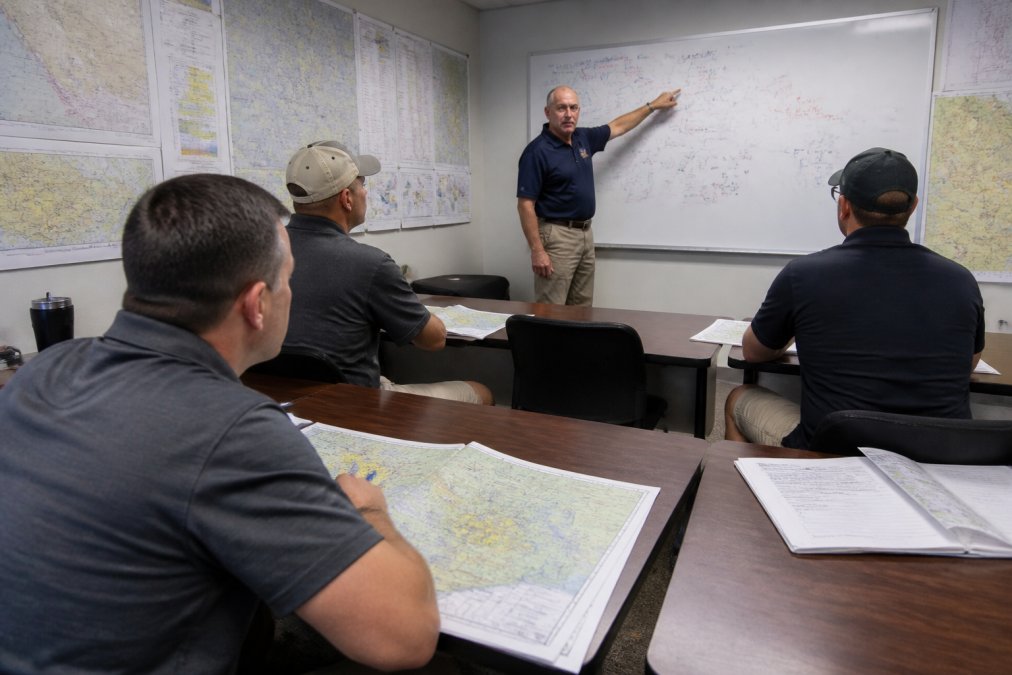
What separates a 200-hour program that produces hireable dispatchers from one that barely clears the regulatory minimum comes down to curriculum design and instructional quality.
Meteorology, Aerodynamics, and Aviation Law
A serious dispatch training curriculum spends substantial time on meteorology because weather is the dispatcher's primary operational variable. Students learn to read and interpret METARs, TAFs, SIGMETs, AIRMETs, prog charts, and winds-aloft forecasts. They study frontal systems, icing conditions, and thunderstorm development.
Aerodynamics instruction covers aircraft performance envelopes and how airframe limitations translate into dispatch decisions. Aviation law covers the dispatcher's legal co-authority with the pilot-in-command under 14 CFR Part 121 and the dispatcher's liability exposure.
This material is dense and requires instructors who have operated in the industry.
Weight and Balance, Flight Operations, and Dispatch Console Skills
Weight and balance computation is where many candidates with limited math backgrounds feel anxiety. A well-structured program treats this as a teachable skill. Students work through actual aircraft loading scenarios and develop the discipline to catch errors before they become operational problems.
Flight operations instruction covers fuel planning, alternate airport selection, ETOPS requirements, and the mechanics of releasing a flight. Dispatch console skills bridge classroom knowledge and the real environment: students learn to manage concurrent calls, monitor multiple flights simultaneously, and operate under time pressure.
Is 200 Hours of Dispatch Training Actually Enough to Pass?
200 hours of dispatch training is enough to pass the ADX written exam and the oral practical test, provided the curriculum is comprehensive, the instruction is expert-led, and the student engages seriously with the material. The regulatory minimum and the practical minimum are the same number here, which is unusual in aviation training.
Two programs can both deliver 200 classroom hours and produce wildly different outcomes. A program that uses large classes and recorded lectures will leave students underprepared for the oral exam. A program with small class sizes, instructors who use the Socratic Method, and real-world scenario practice will produce candidates who can defend a flight plan under examiner pressure.
The question isn't "is 200 hours enough?" It's "200 hours of what, taught by whom, in what environment?"
For candidates coming from outside aviation, the instructional environment matters even more. Small class sizes allow instructors to identify individual knowledge gaps before they become exam failures.
| Training Factor | Impact on Exam Readiness |
|---|---|
| Class size | Small classes allow targeted gap-filling before the oral exam |
| Instructor background | Active airline experience improves practical scenario training |
| Curriculum balance | Written and oral prep must both be explicit, not implied |
| Scenario practice | Simulated flight releases build confidence oral examiners test |
| Ground school supplement | Reinforces technical knowledge between classroom sessions |
How to Become a Certified Aircraft Dispatcher: Step by Step
Becoming a certified aircraft dispatcher follows a defined sequence. Skipping steps or underestimating any stage is how candidates end up retaking exams.
-
Confirm eligibility. You must be at least 23 years old and able to read, speak, write, and understand English. Review FAA Aircraft Dispatcher Certificate requirements to confirm current eligibility criteria before enrolling.
-
Select an FAA-approved Part 65 training program. Evaluate class size, instructor credentials, curriculum depth, and pass rate transparency. Programs approved under 14 CFR Part 65 have met FAA standards for curriculum content and instructor qualification.
-
Complete the 200-hour approved curriculum. Attend every session. The material compounds, and missing fundamentals will undermine your ability to reason through scenarios later in the course.
-
Apply for and pass the ADX written knowledge test. Schedule the exam through an FAA-approved testing center. QNH LLC includes a free Gleim Online Ground School course with fall class registration to support written exam preparation.
-
Schedule the oral practical test. Once your written test is passed and your training is complete, schedule the oral practical with a Designated Pilot Examiner.
-
Receive your Aircraft Dispatcher Certificate. Upon successful completion of the oral practical, the FAA issues your certificate.
-
Begin the job search. Certification is the credential. Hirability depends on how well your training prepared you to perform on the line.

What Bad Advice About Dispatch Certification Gets Wrong
Most misleading content about dispatch certification falls into one of three categories.
"Any 200-hour program is basically the same." This is wrong. The FAA sets the minimum hour requirement and curriculum categories, but it does not standardize instructional quality, class size, or the depth of practical scenario training. Two programs can both be FAA-approved and produce candidates with dramatically different levels of exam readiness.
"Online-only programs are just as good as in-person." For some knowledge domains, online delivery works. Dispatch is not one of them. The oral practical exam tests your ability to reason through complex, time-pressured scenarios in real time while an examiner challenges your decisions. That skill is built through live instruction. The Socratic Method, which forces students to defend their reasoning, is a classroom technique that does not translate to self-paced online modules.
"Pass the written test and you're basically done." The written test is the easier hurdle. Candidates who over-index on written exam prep and underinvest in practical scenario training often pass the written comfortably and then struggle in the oral.
The oral practical exam rewards confident, structured reasoning more than encyclopedic recall. Programs that build that reasoning capacity through small-group discussion, scenario challenges, and instructors who push back on incomplete answers produce better outcomes.
The ROI of Investing 200 Hours in Dispatch Certification
Two hundred hours is a meaningful commitment. For anyone weighing the investment, the return is worth examining clearly.
Aircraft dispatchers hold a federally regulated certificate that carries legal co-authority over commercial flight operations. That credential does not expire without cause, and the skills it certifies are in demand across the commercial aviation industry. According to Bureau of Labor Statistics Occupational Outlook for Air Traffic Controllers and Airfield Operations Specialists, aviation operations roles consistently require formal certification, and demand tracks closely with commercial airline capacity.
The ROI calculation has three components. First, the direct career value: a dispatcher certificate opens the door to a professional aviation career that does not require a pilot's license. Second, the speed to employment: a well-structured 200-hour program can be completed in weeks, not years. Third, the quality differential: candidates from rigorous, small-class programs with experienced instructors tend to perform better in interviews and on the line.
What most ROI discussions miss is the cost of failure. A candidate who completes a low-quality program, fails the oral practical, and must retake it has spent more in total time and money than a candidate who invested in rigorous instruction the first time. The upfront cost of quality instruction is not a premium. It's a hedge against the far higher cost of inadequate preparation.
For internal airline candidates and career-changers alike, the 200-hour dispatch certification curriculum is one of the most efficient credentialing paths in commercial aviation.
Dispatch certification is a high-stakes credential, and the quality of your preparation determines whether those 200 hours produce a hireable candidate or a candidate who needs to go back through the process. QNH LLC delivers FAA-approved Part 65 Aircraft Dispatcher Certification training with small class sizes, instruction from college professors, airline pilots, and former FAA Dispatcher Examiners, and a curriculum that prepares students for both the written ADX exam and the oral practical. With a 200-classroom-hour program built on the Socratic Method and practical flight operations training, QNH LLC gives candidates the preparation they need to pass the first time and perform on the line. Reserve now and take the first step toward your dispatch certificate.
Frequently Asked Questions
How many classroom hours are required for an FAA-approved dispatcher course?
FAA regulations under 14 CFR Part 65 set a minimum of 200 classroom hours for an approved aircraft dispatcher certification program. Those hours must cover specific subject areas including meteorology, aerodynamics, aircraft systems, air traffic control procedures, and flight operations. Programs that meet this standard qualify students to sit for the ADX written exam and the subsequent oral practical exam administered by an FAA-designated examiner.
Is 200 hours of training sufficient to pass the FAA Aircraft Dispatcher exam?
200 hours is the FAA-mandated minimum, and a well-structured dispatch certification program can absolutely prepare you to pass both the written and oral practical exams within that time. The difference lies in how those hours are used. Small class sizes, experienced instructors, and a curriculum built around critical thinking rather than rote memorization give students a significantly stronger foundation than programs that simply log hours against a checklist.
What topics are covered in a 200-hour aircraft dispatcher curriculum?
A 200-hour aircraft dispatcher training curriculum covers meteorology and weather interpretation, aerodynamics, aircraft performance, aviation regulations, air traffic control procedures, weight and balance computations, flight planning, and dispatch console operations. Ground school components address regulatory compliance and career readiness. Practical exercises focus on concurrent monitoring of multiple flights, building the decision-making skills the FAA oral practical exam directly tests.
Are there prerequisites before starting a 200-hour dispatcher program?
The FAA requires applicants for the Aircraft Dispatcher Certificate to be at least 23 years old and able to read, speak, write, and understand English. No prior aviation experience is formally required before enrolling in a Part 65-approved course, making the program accessible to career changers. That said, comfort with basic math and a willingness to engage with technical material will help you keep pace, particularly during weight and balance and flight operations modules.
This article was written using GrandRanker