 listicle
Common FAA Oral Exam Mistakes to Avoid
Last Updated: November 11, 2026
Quick Summary
The most common oral exam mistakes are weak knowledge of aircraft systems and limitations, shaky weight and balance or performance math, incomplete fuel planning and weather decisions, and memorizing answers instead of explaining reasoning. Examiners test how you think, so explain why each rule exists and correct wrong answers calmly.
- Read the POH cover to cover and explain why each limitation exists.
- Practice weight and balance and performance math out loud until it feels routine.
- Layer your fuel plan: regulatory reserve first, then personal reserve and contingency margin.
- Check alternate forecasts against alternate minimums at your planned arrival time.
- If you give a wrong answer, pause, correct it with reasoning, and continue calmly.
Table of Contents
- Why Oral Exam Mistakes Cost Candidates Their Certificate
- Mistake 1: Weak Knowledge of Aircraft Systems and Limitations
- Mistake 2: Shaky Weight and Balance and Performance Calculations
- Mistake 3: Incomplete Fuel Planning, Alternates, and Weather Decisions
- Mistake 4: Memorizing Answers Instead of Explaining Reasoning
- How to Recover After an Incorrect Answer
- Building a Structured FAA Oral Exam Study Guide
- Booking Your Oral Exam Preparation at QNH
- Frequently Asked Questions
Why Oral Exam Mistakes Cost Candidates Their Certificate
Oral exam mistakes are one of the most common reasons aviation candidates walk out of an examiner's office without the certificate they came for. The same errors tend to repeat across candidates who are otherwise well prepared. The good news is that most of them are predictable and fixable before the day of the exam.
The oral portion tests whether you understand what you are flying, not just whether you can recite facts. Examiners use open questions to see how you think through a problem, how you manage risk, and whether your answers hold together under follow-up questioning. Practical guidance on reasoning through examiner questions under pressure can help you prepare for that. A candidate who knows the material but cannot explain it clearly often struggles more than one who knows slightly less but reasons well.
Below, we cover four mistakes that come up repeatedly, followed by a practical method for recovering when you give a wrong answer. We close with a structured study approach you can start this week.
Mistake 1: Weak Knowledge of Aircraft Systems and Limitations
Questions about the fuel system, electrical system, engine limitations, and placards come up early and often.
Read the aircraft's Pilot's Operating Handbook (POH) cover to cover, and build a short sheet of the limitations you are most likely to be asked about: airspeeds, weight limits, oil and fuel capacities, and operating temperature ranges. Then practice explaining why each limit exists. Stating a limit is an answer; explaining how that limit affects climb performance and structural margin is understanding.
Mistake 2: Shaky Weight and Balance and Performance Calculations
Weight and balance and performance questions are where many candidates lose confidence fast. The math itself is not hard, but examiners ask you to work it out while talking, and small arithmetic errors can cascade into a wrong conclusion about whether the flight is safe.
Practice the full calculation until it feels routine: loaded weight, moment, center of gravity, and comparison against the envelope. A practical training guide to weight and balance computations walks through each step if you are still struggling. Do the same for density altitude and takeoff and landing distance using the POH charts. Then rehearse talking through each step out loud, because that is how the examiner will evaluate you. Stopping to say "I need to check the chart again, here's why" is far better than silently guessing.
Mistake 3: Incomplete Fuel Planning, Alternates, and Weather Decisions
Fuel planning and go/no-go decisions reveal how you manage risk, which is exactly what examiners are looking for. The most common error is not a math mistake, it is answering with trip fuel only and stopping there. Under the regulations, your fuel plan has layers, and an examiner will usually walk you up the ladder one rung at a time to see whether you know where each layer comes from.
Build your answer around the layers in order. For a worked method, see how to calculate fuel reserves for long-haul flights. For a flight under visual flight rules, the regulatory minimum is enough fuel to reach the first point of intended landing and then fly after that for at least 30 minutes during the day, or 45 minutes at night. For a flight under instrument flight rules, the planning figure is enough to fly to the destination, then to an alternate if one is required, and then for 45 minutes at normal cruising speed.
Alternates are the second half of the question. Naming an airport is not enough; you have to show it is suitable at your planned arrival time. That means checking the forecast ceiling and visibility against the alternate minimums that apply to your operation, confirming the runway and approach you would use are usable, and noting whether the airport has fuel and services if you actually need them. A candidate who says "I'd use the field 30 miles east" without checking its forecast is giving the examiner an easy follow-up.
Weather is where the decision-making shows. Be ready to read a METAR and a TAF line by line and translate each group into a plain-language statement: wind direction and speed, visibility, ceiling, weather, and any trend. Then connect the forecast to your personal minimums and to your alternate. Vague answers such as "the weather looks okay" will not hold up.
Watch out: candidates often quote a reserve figure without knowing whether it is the regulatory minimum or their own personal margin, and examiners probe exactly that distinction.
A realistic scenario ties the pieces together. Suppose you are planning a 2.5-hour cross-country with a forecast of scattered clouds at 4,000 feet and a chance of afternoon thunderstorms near the destination. Walk through it out loud: fuel to destination plus alternate plus 45 minutes, an alternate with a forecast that holds above minimums at your arrival time, a personal cutoff for convective activity, and a diversion airport along the route. Re-running the decision when conditions change is easier when you have practiced adapting to scenarios through in-person flight training.
The table below summarises the fuel reserve and planning layers the article describes, so you can see what each one requires at a glance.
| Layer | Requirement | Note |
|---|---|---|
| VFR regulatory reserve | Reach first landing point, then 30 min (day) or 45 min (night) | Regulatory floor |
| IFR planning figure | Destination, then alternate if required, then 45 min at cruise | Regulatory planning figure |
| Personal reserve | Set by pilot judgment | Not regulatory |
| Contingency margin | Set by pilot judgment | Covers forecast winds, single runway, limited services |
| Alternate suitability | Forecast ceiling and visibility above alternate minimums at arrival | Check runway, approach and services |
| Weather interpretation | Translate METAR and TAF groups into plain statements | Connect to personal minimums and alternate |
Mistake 4: Memorizing Answers Instead of Explaining Reasoning
This is the mistake that most often separates candidates who pass from those who do not. Memorized answers fall apart the moment the examiner changes one variable. "What if the winds were 20 knots instead?" exposes a script with no understanding behind it.
Shift your preparation toward explaining the reason behind every answer. For each rule or procedure, ask yourself why it exists and what would happen without it. Practice with a partner who asks follow-up questions, and get comfortable saying "I don't know, but here's how I would find out." Examiners often respect that answer more than a confident guess.
How to Recover After an Incorrect Answer
Everyone gives a wrong answer at some point, and examiners know that. What matters is how you respond. Candidates who freeze or argue tend to lose more points than the original error cost them.
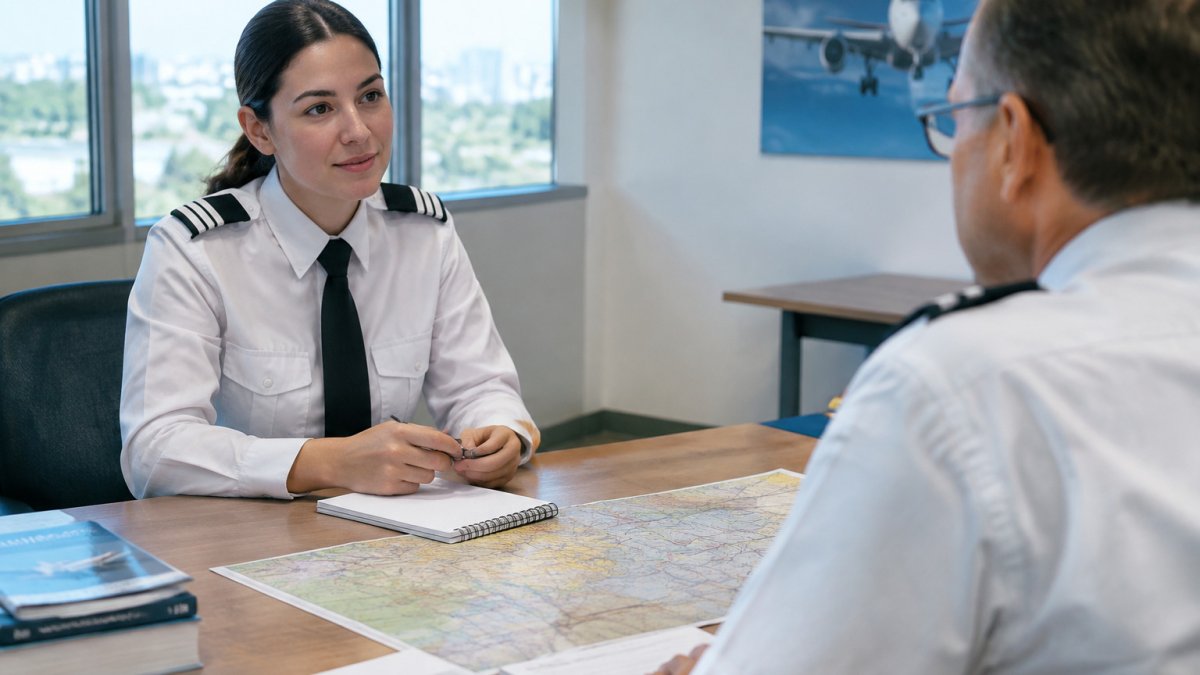
When you realize an answer is wrong, pause briefly, say that you want to correct it, and give the right answer with the reasoning. A simple statement such as "Let me correct that, the correct limit is X because Y" shows self-awareness, which is a trait examiners value. Do not over-apologize or rush through the correction. Then continue calmly with the next question. Practicing this recovery in mock oral sessions makes it feel natural on exam day.
Building a Structured FAA Oral Exam Study Guide
A structured study guide turns scattered review into steady progress, and the strongest preparation is built around the Airman Certification Standards rather than around a question bank. You can compare the best study resources available for FAA oral exams before settling on your materials. For a complete step-by-step study plan for FAA aviation exams, see the seven-step approach we outline.
Start with a gap map. Print or open the ACS for your certificate and rating and go through each task area, regulations, aircraft systems, performance and weight and balance, weather, airspace, navigation, and risk management. Mark each area green, yellow, or red based on whether you can explain it cold, explain it with notes, or stumble. The red and yellow areas become your study queue, in that order. This is more honest than re-reading material you already know, and it keeps you from confusing familiarity with understanding.
Then build a reference shelf you can actually cite. For each task area, note the primary source: the relevant regulation, the applicable FAA handbook chapter, the chart supplement entry, and the aircraft documents in your POH.
Run mock orals on a schedule, not on a whim. Two or three sessions before the exam is a reasonable floor, but the format matters more than the count. Ask an instructor to play the examiner and to change one variable after every answer, stronger winds, a lower ceiling, a heavier load, so you practice reasoning rather than reciting.
Keep a mistake log. After each session, write down every question you missed or answered shakily, the correct answer, the source, and the reason you missed it, a knowledge gap, a misread question, or a reasoning slip. Review the log before the next session and retire entries only when you can answer them cleanly twice in a row. A log turns a pile of notes into a shrinking list, which is far more motivating than re-reading a handbook.
Watch out: the most common failure in a self-built study plan is spending time on green areas because they feel good, while the red areas stay untouched until the last week.
Finally, tailor the plan to your aircraft and your operating area. Generic advice misses the details that actually come up: the specific fuel system in your airplane, the airspace and terrain around your home field, the alternates you would really use, and the local weather patterns that drive your go/no-go calls. Build a one-page checklist of those local specifics and review it alongside the ACS.
Booking Your Oral Exam Preparation at QNH
If you want structured practice that targets these exact mistakes, QNH LLC offers instruction designed to build reasoning, not just recall. Our program includes small classes, individual attention, and instructors with airline and examiner experience who can run realistic mock orals. Contact QNH LLC to ask about current class schedules and enrollment, and for current pricing, please contact QNH LLC directly.
Frequently Asked Questions
What are the most common mistakes students make during an FAA oral exam?
The most frequent problems are vague answers, memorized responses that fall apart under follow-up questions, and weak understanding of aircraft limitations, weight and balance, and fuel planning. Candidates also often skip the reasoning behind a decision. Examiners want to hear why you chose an action, not only what the rule says. Practicing aloud with a mock oral partner exposes these gaps before the real exam, when they are easier to fix.
How should you respond when you do not know an answer during an FAA oral exam?
Say so plainly, then explain how you would find the answer. For example, state which reference you would check, such as the Aircraft Flight Manual, the current FAA publications, or the applicable regulation, and walk through your reasoning. Examiners generally reward honesty and sound judgment more than a guess delivered with confidence. Avoid bluffing, since a made-up answer usually leads to follow-up questions that expose the gap.
What documents should you review before an FAA oral exam?
Review the Airman Certification Standards for your certificate, your aircraft's Pilot's Operating Handbook or Aircraft Flight Manual, and your own logbook and endorsements. Also review the weather products, charts, and planning tools you plan to use in the exam. Confirm that your required documents, such as your pilot certificate, medical certificate, and government-issued photo identification, are valid and ready for the examiner.
How can you practice explaining aviation concepts out loud?
Use a mock oral with an instructor or a study partner who asks unscripted follow-up questions. Work through scenarios such as a weather change on a planned cross-country or a performance question at a high-density-altitude airport, and talk through each decision step by step. Recording yourself and listening back helps you catch vague wording and unclear reasoning.