 how-to
Aircraft Dispatcher License Without Experience: 2026 Guide
Table of Contents
- What the FAA Actually Requires to Become a Dispatcher
- FAA Part 65 Certification Requirements Explained Plainly
- Aircraft Dispatcher Training Program Duration: What 200 Hours Really Means
- How to Pass the FAA Aircraft Dispatcher Exam Without Aviation Experience
- Paying for Flight Dispatcher Training: Funding Options Most Guides Skip
- Online vs. In-Person Dispatcher Training: What Actually Prepares You
- A Day in the Life of an Aircraft Dispatcher (Reality Check)
- Frequently Asked Questions
- Conclusion
Last Updated: September 16, 2026
What the FAA Actually Requires to Become a Dispatcher
The FAA does not require prior aviation experience to issue an aircraft dispatcher license. What it requires is that you meet the eligibility rules in Part 65 and complete an approved certification program. That distinction matters: the barrier isn't a flight log, it's a structured course and a passed exam.
At QNH LLC, we've watched career-changers walk in with zero aviation background and walk out with a dispatch certificate. The path is regulated, but it's open.
Part 65 Eligibility: Age, Language, and Medical Basics
Applicants must be at least 23 years old to hold the certificate, though training can begin earlier. You must read, speak, and understand English, and you'll need to pass a medical exam or hold a current medical certificate.
Here's the part most people miss: the FAA rules live in 14 CFR Part 65, and they say nothing about needing flight hours or airline employment first. The requirements are age, language, medical fitness, and completed training. Nothing else.
FAA Part 65 Certification Requirements Explained Plainly
FAA Part 65 certification requirements boil down to three gates: eligibility, an approved training course, and two exams. Clear all three and you're certified.
The three gates are:
- Meet age, language, and medical eligibility
- Complete an FAA-approved dispatcher course
- Pass the written knowledge test and the practical exam
Each gate is sequential. You can't sit the exams without documenting your training, and you can't hold the certificate without passing both exams.
The Written Knowledge Test: What It Covers
The written examination is a multiple-choice test covering the full dispatcher syllabus. Expect questions on meteorology, navigation, federal aviation regulations, flight planning, and aircraft performance.
A common mistake is treating the written exam as the finish line. It isn't. It's the entry ticket to the practical exam, and the two test different muscles. The written checks recall; the practical checks judgment.
Aircraft Dispatcher Training Program Duration: What 200 Hours Really Means
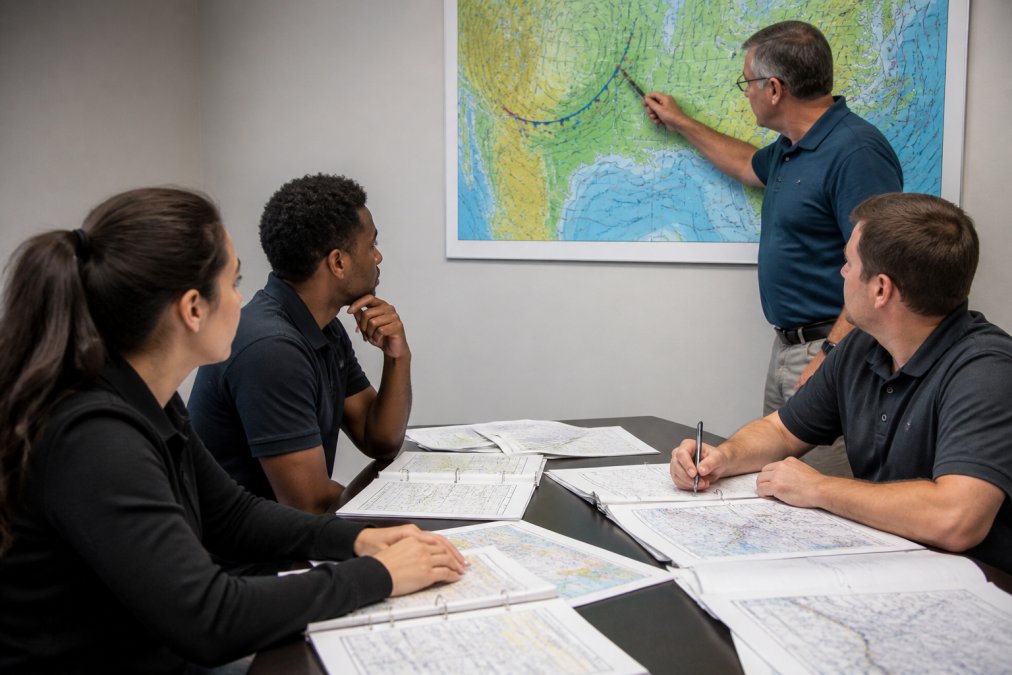
An FAA-approved dispatcher course must include a minimum of 200 hours of instruction. That number is a regulatory floor, not a description of how the time is used, and the difference between programs is mostly in how those hours are allocated.
A typical full-time program runs five to six weeks, five days a week, roughly six to seven hours of instruction per day. A part-time program stretches the same 200 hours across ten to sixteen weeks, usually in evening or weekend blocks. Both satisfy the same requirement; they differ in pace and in how much time you have to absorb the material between sessions.
How the 200 Hours Are Actually Spent
The subject blocks are set by the regulation, but the split between lecture, simulation, and hands-on flight planning is not. A common pattern in strong programs looks like this:
- Meteorology and weather analysis, a substantial block, because weather drives most dispatch decisions
- Aircraft performance, weight and balance, computation-heavy, best learned with repetition
- Federal aviation regulations and operational control, the rules that define what a dispatcher is legally responsible for
- Flight planning and dispatch release construction, the integrative block where the other subjects come together
- Navigation and air traffic control coordination, how the dispatcher fits into the wider system
- Practical application and exam preparation, full scenario runs and release defense practice
The last block is where programs diverge most. Some spend a large share of the 200 hours on lecture and reserve only a small window for scenario practice. Others invert that. The practical exam rewards the second approach, because it tests whether you can defend a release out loud under pressure, not whether you can recite a definition.
What the Schedule Actually Feels Like
For career-changers, the schedule is the part that gets underestimated. A full-time program is effectively a full-time job for five to six weeks, with reading and practice outside class hours. A part-time program is more forgiving on paper but requires sustained discipline over three to four months, often after a full workday.
Most practitioners find the part-time route is more realistic for people who cannot take several weeks off work, but it demands a consistent study routine. The full-time route compresses the learning curve and tends to produce stronger practical-exam performance, because the material stays fresh between sessions.
What Happens After the 200 Hours
Finishing the course does not make you a dispatcher. It makes you eligible to sit the written and practical exams. The gap between course completion and first job offer is where most career-changers lose momentum, and it is the part most program descriptions do not address.
A realistic sequence after graduation looks like this:
- Pass the written knowledge test
- Pass the practical exam and receive your certificate
- Apply to regional carriers, cargo operators, and charter operations, which are the most common entry points for dispatchers without prior airline experience
- Expect a training period with your employer before you work a live desk unsupervised
Job placement varies widely by program and by hiring cycle. Some programs publish placement figures; many do not. If placement data matters to you, ask the program directly for recent graduate outcomes rather than relying on marketing language, and ask whether they maintain employer relationships with the operators that actually hire entry-level dispatchers.
A Day in the Life: The Reality Check Most Programs Skip
A dispatcher shares operational control of every flight with the pilot in command. That is the legal core of the job, and it shapes the daily reality.
A shift involves monitoring weather across the route network, building and amending flight plans, calculating fuel and weight and balance, issuing dispatch releases, and staying in contact with crews and air traffic control.
How to Pass the FAA Aircraft Dispatcher Exam Without Aviation Experience
You pass by treating the two exams as separate skills. The written exam rewards structured study; the practical exam rewards the ability to defend a flight plan out loud.
Here's a workable sequence:
- Finish your approved course before scheduling either exam
- Drill the written test with practice questions until recall is automatic
- Build full dispatch releases for practice flights, start to finish
- Rehearse defending those releases aloud, under time pressure
- Sit the written exam, then the practical
Practical Exam: Defending a Flight Plan to an Examiner
The practical exam is an oral and scenario-based test where a designated aircraft dispatcher examiner hands you a flight and asks you to defend every decision. You'll justify routing, fuel, weather alternates, and the dispatch release itself.
Paying for Flight Dispatcher Training: Funding Options Most Guides Skip
Most guides list the requirements and stop. Funding is where career-changers actually get stuck, so here's the honest landscape.
Common funding routes include:
- Employer tuition assistance if you already work for an airline
- Workforce development and vocational training grants
- Federal student aid, where the program qualifies
- Payment plans offered directly by training providers
- Veterans education benefits for eligible applicants
Online vs. In-Person Dispatcher Training: What Actually Prepares You
Online courses win on flexibility and cost. In-person programs win on the thing the practical exam actually tests: doing the work in a room, with an instructor correcting you in real time.
A Day in the Life of an Aircraft Dispatcher (Reality Check)
A dispatcher shares operational control of every flight with the pilot in command. That's the job in one sentence, and it's heavier than it sounds.
Frequently Asked Questions
How long does it take to get an aircraft dispatcher license?
The FAA requires a minimum of 200 classroom hours of instruction before you can take the knowledge test. Most full-time students finish in about 6 to 8 weeks. Part-time schedules stretch that to 3 or 4 months. After completing training, you still need to pass the FAA written knowledge test and the practical exam. Add 2 to 4 weeks for scheduling and retakes if needed. Some fast-track programs compress the timeline, but the 200-hour floor is set by regulation and cannot be waived.
What are the FAA Part 65 certification requirements for dispatchers?
You must be at least 21 years old, able to read and speak English fluently, and pass both a written knowledge test and a practical exam. The FAA also requires either 200 hours of approved classroom instruction or relevant aviation experience. There is no college degree requirement. A dispatcher certificate is issued under Part 65 after you demonstrate competency in flight planning, meteorology, navigation, federal aviation regulations, and operational control. A designated aircraft dispatcher examiner administers the practical test.
Can I become an aircraft dispatcher without a college degree?
Yes. The FAA does not require a college degree for an aircraft dispatcher license. What matters is completing an FAA-approved Part 65 certification program and passing both exams. Employers may prefer candidates with some college coursework, but they hire based on your certificate, exam performance, and ability to handle operational control under pressure. Many successful dispatchers enter the field from non-aviation backgrounds with no prior flying or dispatch experience.
How much does a FAA dispatcher license cost?
Total cost depends on the training provider, location, and whether you need housing or travel. Tuition covers classroom instruction, materials, and exam fees. Some programs include additional resources like online ground school access. Pricing varies, so contact QNH LLC directly for current tuition and what is included. Financial aid options exist, including workforce development grants, airline tuition reimbursement for internal candidates, and payment plans some schools offer. Ask providers about every fee before enrolling.
Conclusion
The hardest part of earning an aircraft dispatcher license without experience isn't the FAA, it's choosing training that actually prepares you to defend a flight plan under pressure. QNH LLC has delivered FAA-approved Part 65 certification since 1979, with small classes, 200 classroom hours, and instructors who include airline pilots and former FAA Dispatcher Examiners. Reserve now and start building the judgment the practical exam demands.